This is going to be an extensive post as it strikes me that I have never really explained how a block of wood becomes a pen. I decided that I would chronical the work at every stage. I will see how long this post is and may truncate a bit of it for a follow-on post.
The first step in making a pen is to have a kit. In Winnipeg, there is only 1 place to buy pen and pencil kits and that is my favourite store (Lee Valley). There are several mail-order options, but often, I don’t plan well enough ahead to order from my other favourite (William Wood-write – http://www.penblanks.ca). The kits come with all of the metal/brass parts of the pen. Each pen or pencil kit has a different set of parts that are pressed together after turning and finishing to make a functioning pen.
The blanks (wood) are quite small. Most are 3/4 X 3/4 inch X 5 inch long blocks of hard wood. In the example here, the wood is Chechen, which ironically is NOT from Chechnya but from Central America and the West Indies. Sometimes this wood is known as Black poisonwood. The blank is also from Lee Valley.
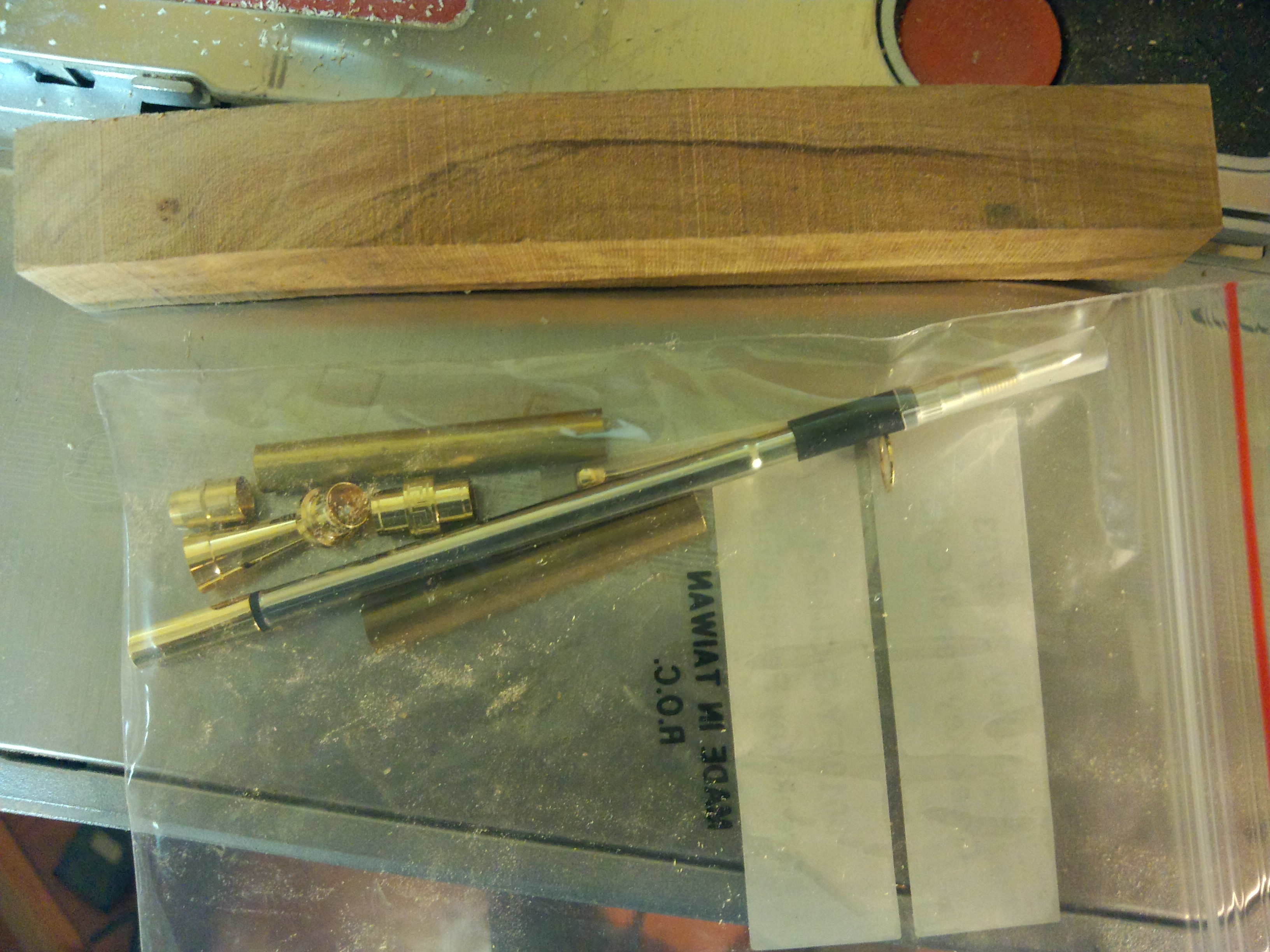
This is a pencil kit with “Greek Key” ornamentation.
The first step is to measure the blank with a brass tube and mark it for cutting. The parts of the blanks have to be cut slightly longer than the brass tube (1/16 to 1/8 inch).
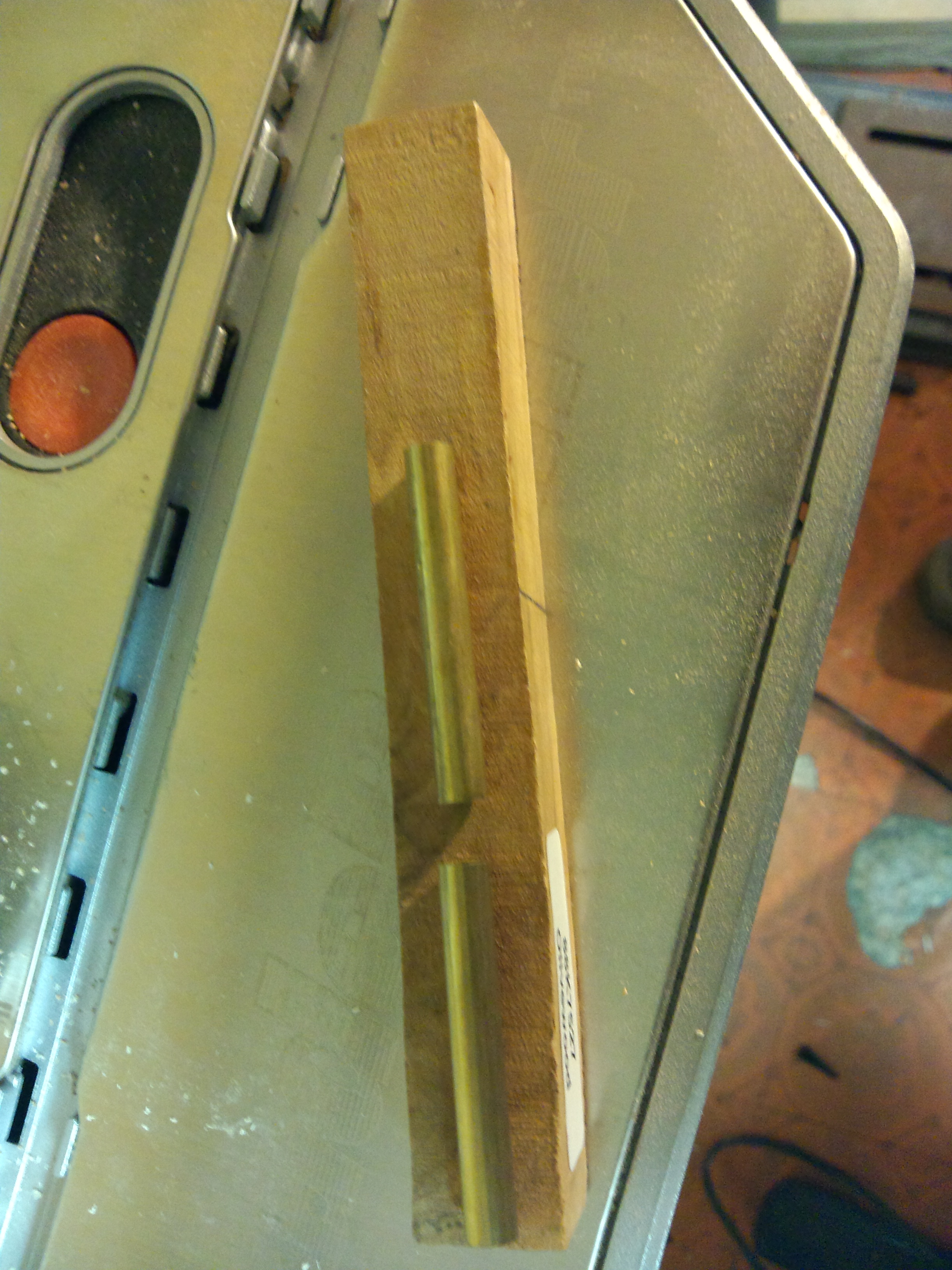
Mark the blank and draw a “square” line as a guide for cutting.
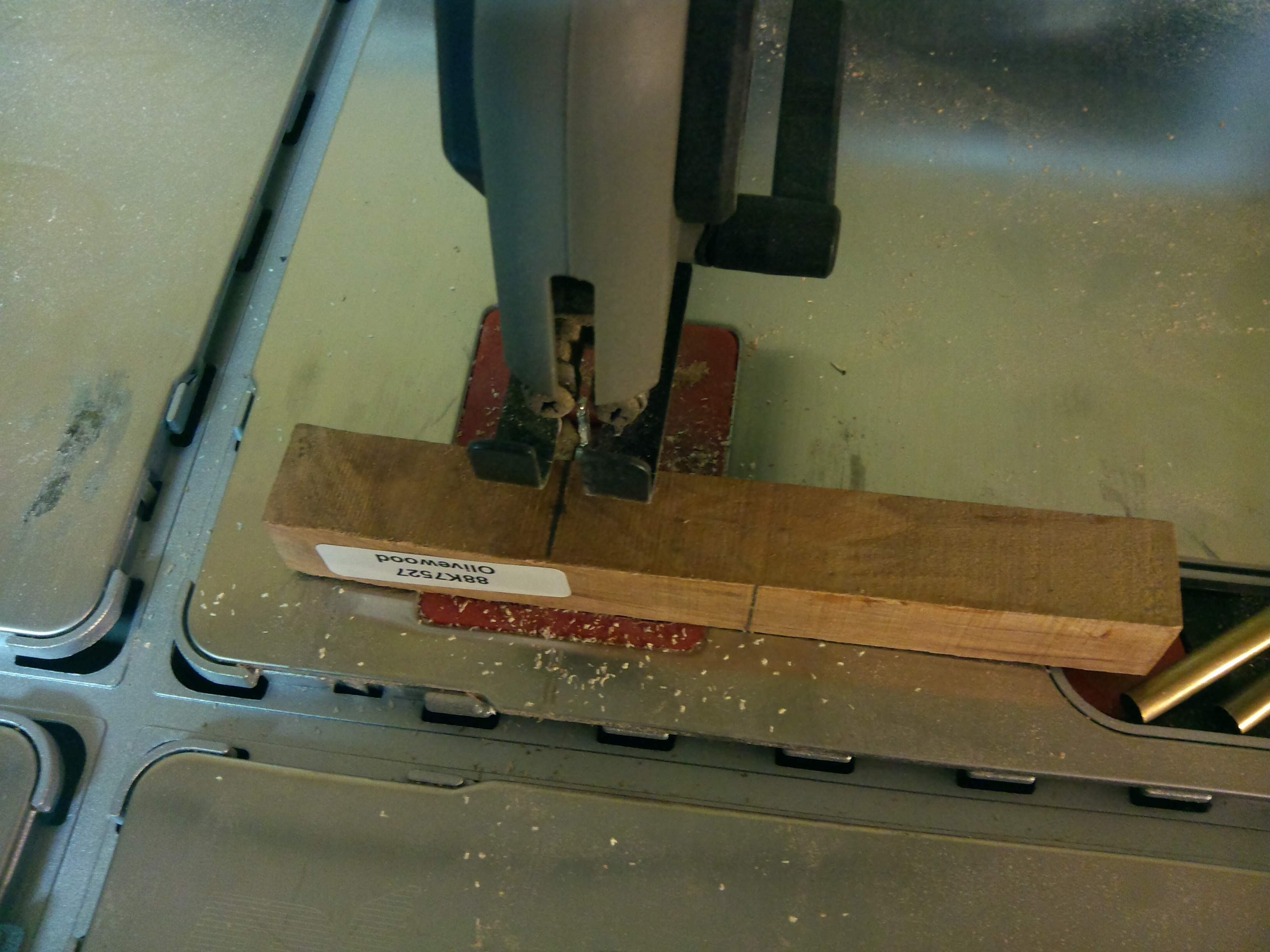
I always mark the blank across the cut mark and then draw arrows so that I can align the grain on the lathe and in the finished piece. Orientation of the grain is quite important. If the grain pattern angle are in opposite directions on the two halves, the pen will look quite strange.
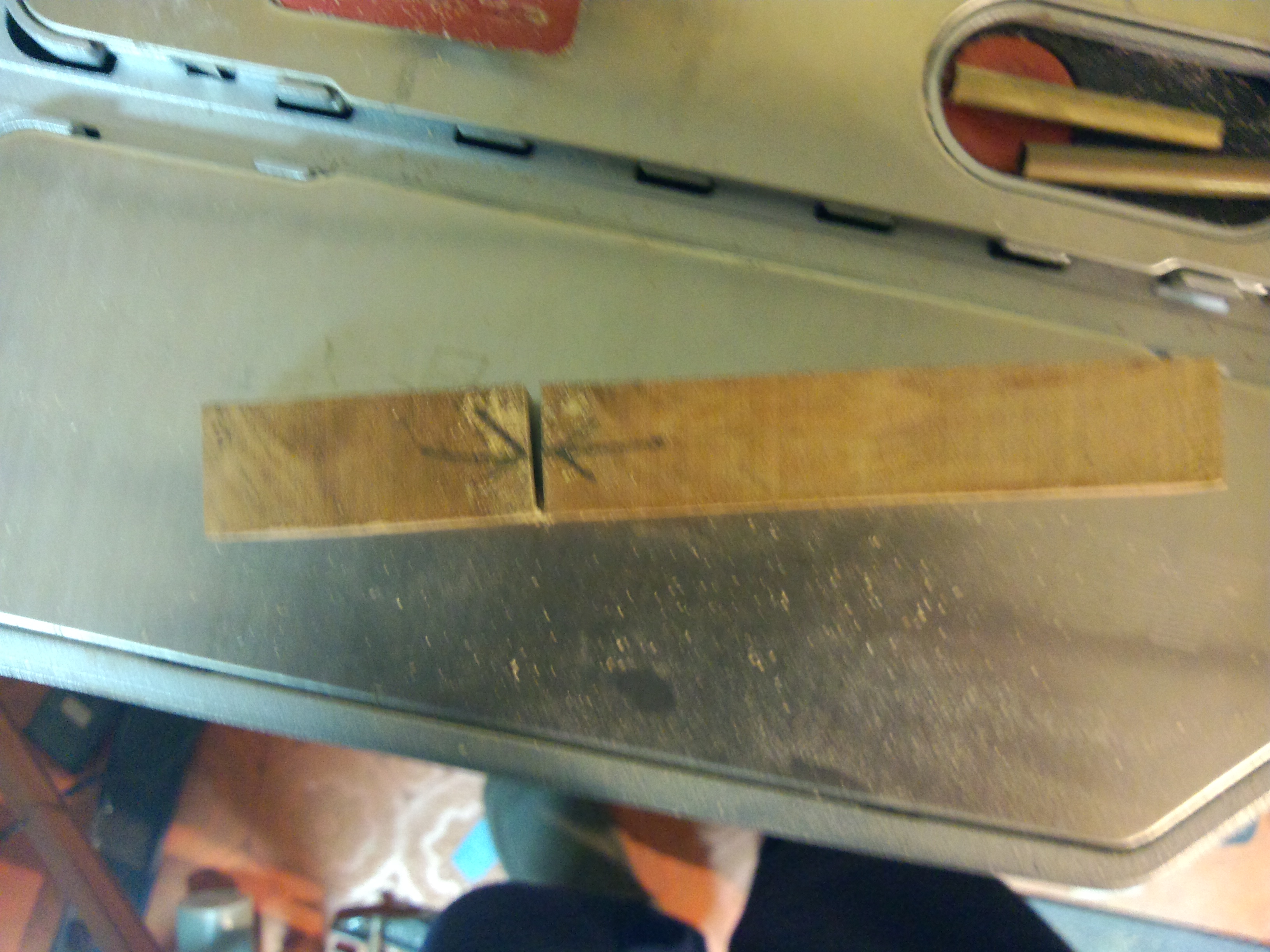
Once the two halves are cut you need to mark the centre of the ends for drilling. The way to find a centre in a square is quite simple. Draw lines from corner to corner each way. The intersection of lines is the centre. In a piece this small it is not overly critical to be precise, in terms of balance on the lathe. It is important though that if you miss the centre in the drill press by too much you run the risk of the bit wandering out the side of the blank. When drilling very hard woods, the drill bit will wander a bit.
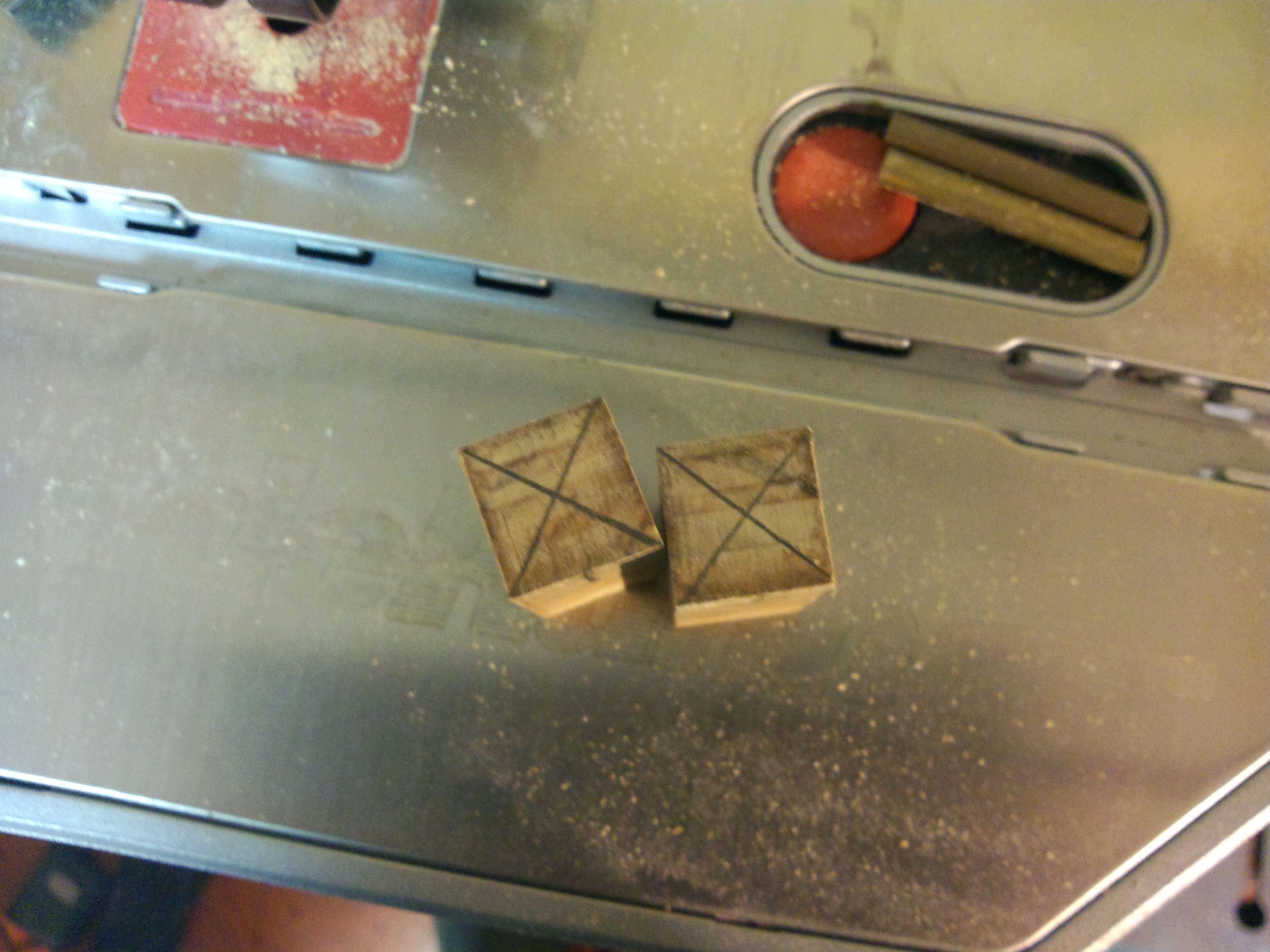
To help the bit bite, you can punch an awl mark on centre.

Once the blanks are ready to go, I then move to the drill press. The kit that you are making will determine the bit size. In this case, the brass tube requires a 7mm hole to be drilled. There are a number of methods or jigs that can be used to keep the blank upright, but I purchased a self-centreing drilling jig from Lee Valley (Do you see a trend here) and this keeps the blanks aligned.

This picture is for illustration only. This jig needs to be clamped to the bed of the Drill Press before I start (clamps not shown). I had been having a lot of trouble lately with blanks blowing out at this stage and the last time I was in Lee Valley, one of the fellows told me I need a bit lubricant to keep the temperature down, so before I drill now, I give the spinning bit a shot of this lubricant. It helps immensely and makes the bit go through the wood like a hot knife through butter.
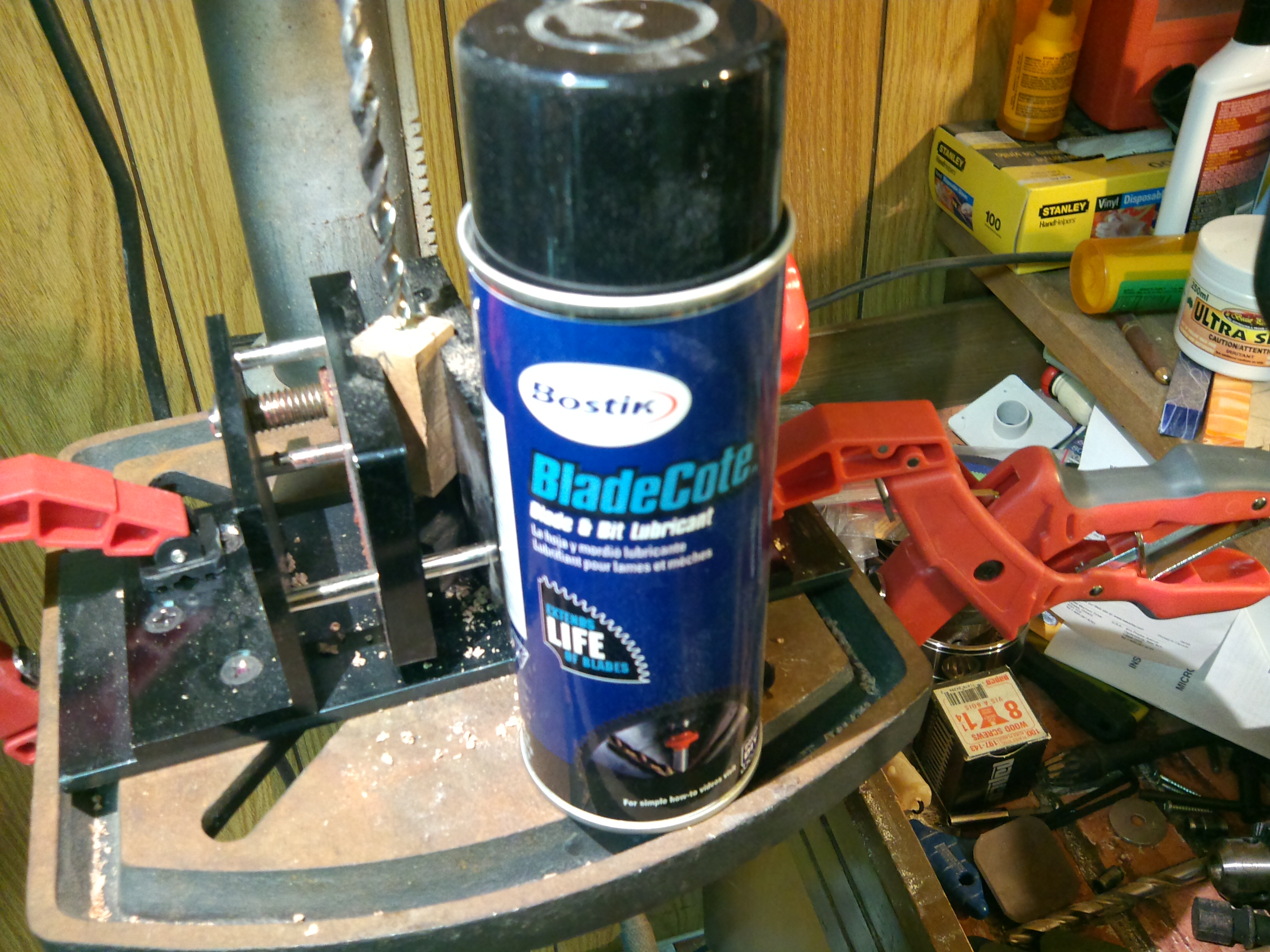
You can see the clamps holding my drill vice down in this picture.
As I was drilling the second blank my drill bit came out of the chuck because I had forgotten to tighten the chuck. This shows how good this lubricant is because the loose chuck was able to go through one of the blanks with no problem.
I saw a YouTube video of a drill press and was advised in this video to tighten all three holes in the chuck when tightening the drill bit. Although it doesn’t make any sense to me, it seems that the bit will wander a bit less if I do. I also find when I am deliberate in tightening all three holes, I don’t (obviously) forget whether the chuck is tight or not.
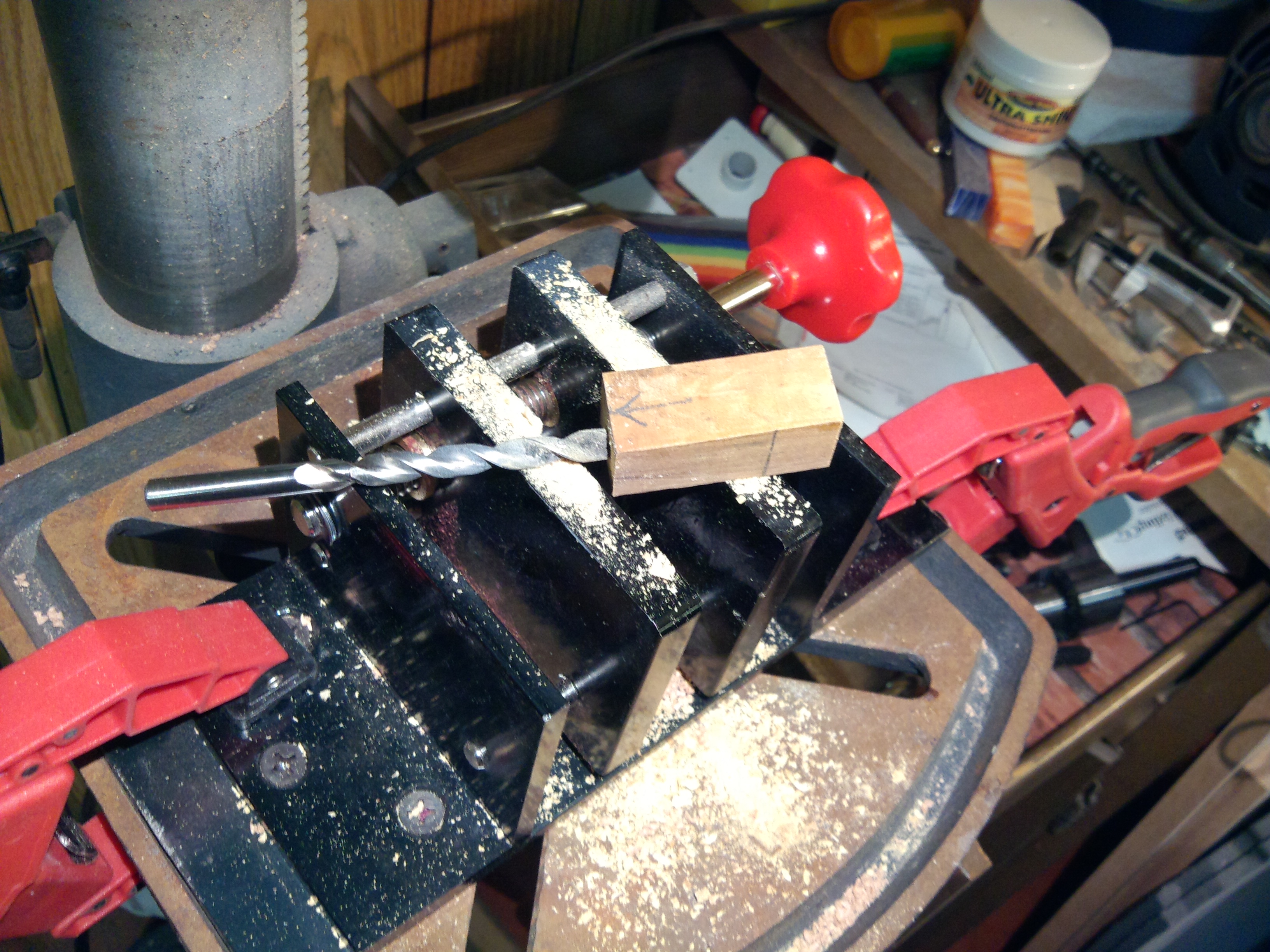
You can see in the next picture just how much the drill bit wanders in this Chechen. If I offset the bit in the top, it would wander too close to the edge of the blank to be of any use.

There are a number of reasons this happens. In hardwood, the grain is normally not very uniform and so the drill bit will move along the grain path where it doesn’t have to work as hard. In the picture above, one half was fine, but the other half was awfully close to being unusable, even though I hit the centre on the other end.
After the two halves are drilled it is time to prepare the tubes for gluing. The brass tubes are very smooth and if you attempt to glue them directly to the smooth wood, the bond will not be at all strong. Taking sandpaper to the tube will give the glue something to adhere to in the blank.
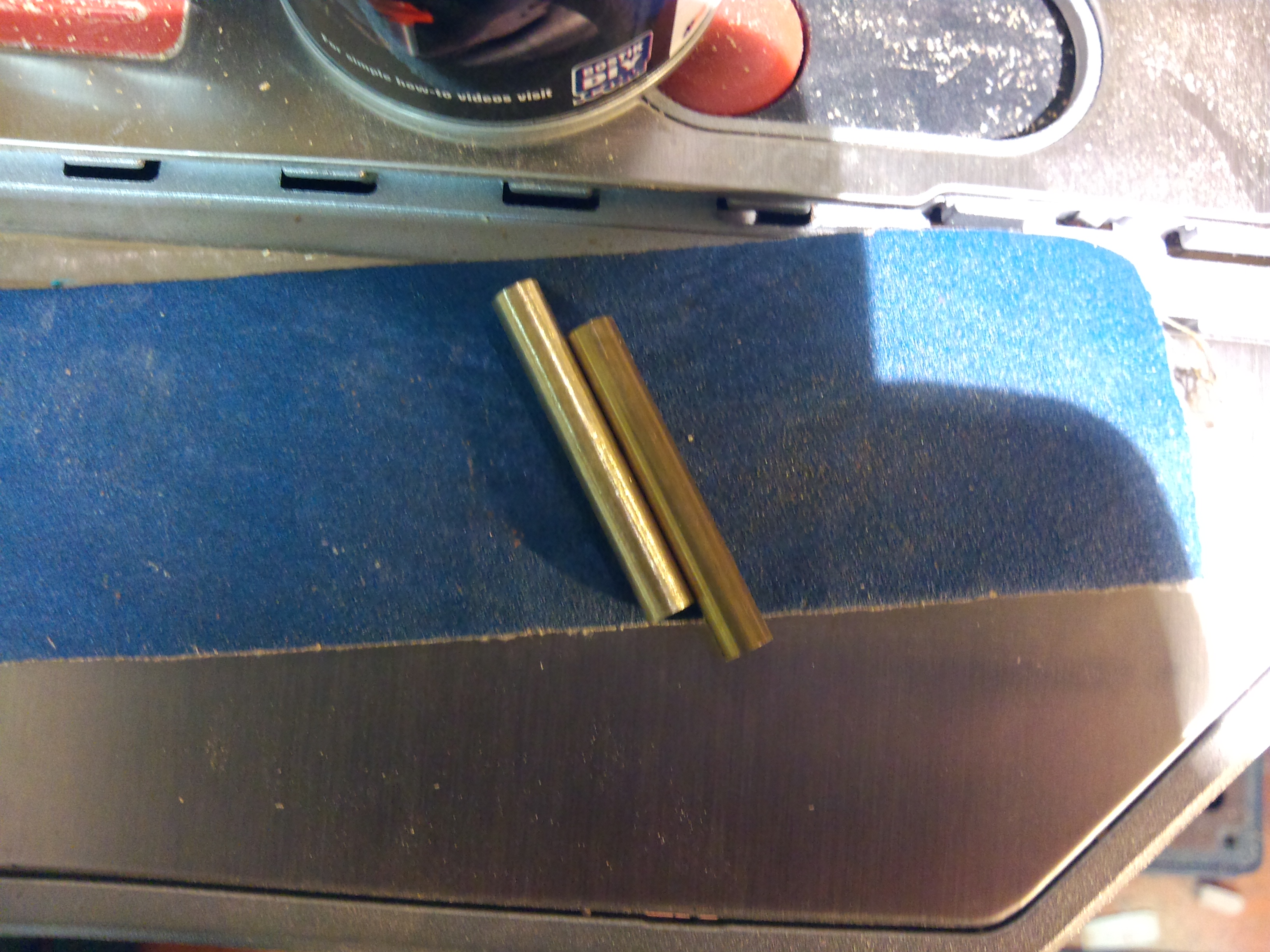
The shiny tube on the left is roughed up.
After the tubes are ready, it is time to glue. I use CA glue, although some people use epoxy. I use CA glue in finishing so it make sense to me to not have to have another glue on hand for the tubes. People use epoxy because it takes longer to set. When you use CA glue, you have to work fairly fast, while getting good coverage with the glue. If you go too slowly you run the risk of having the tube set while it is still jutting out of the blank (like below).
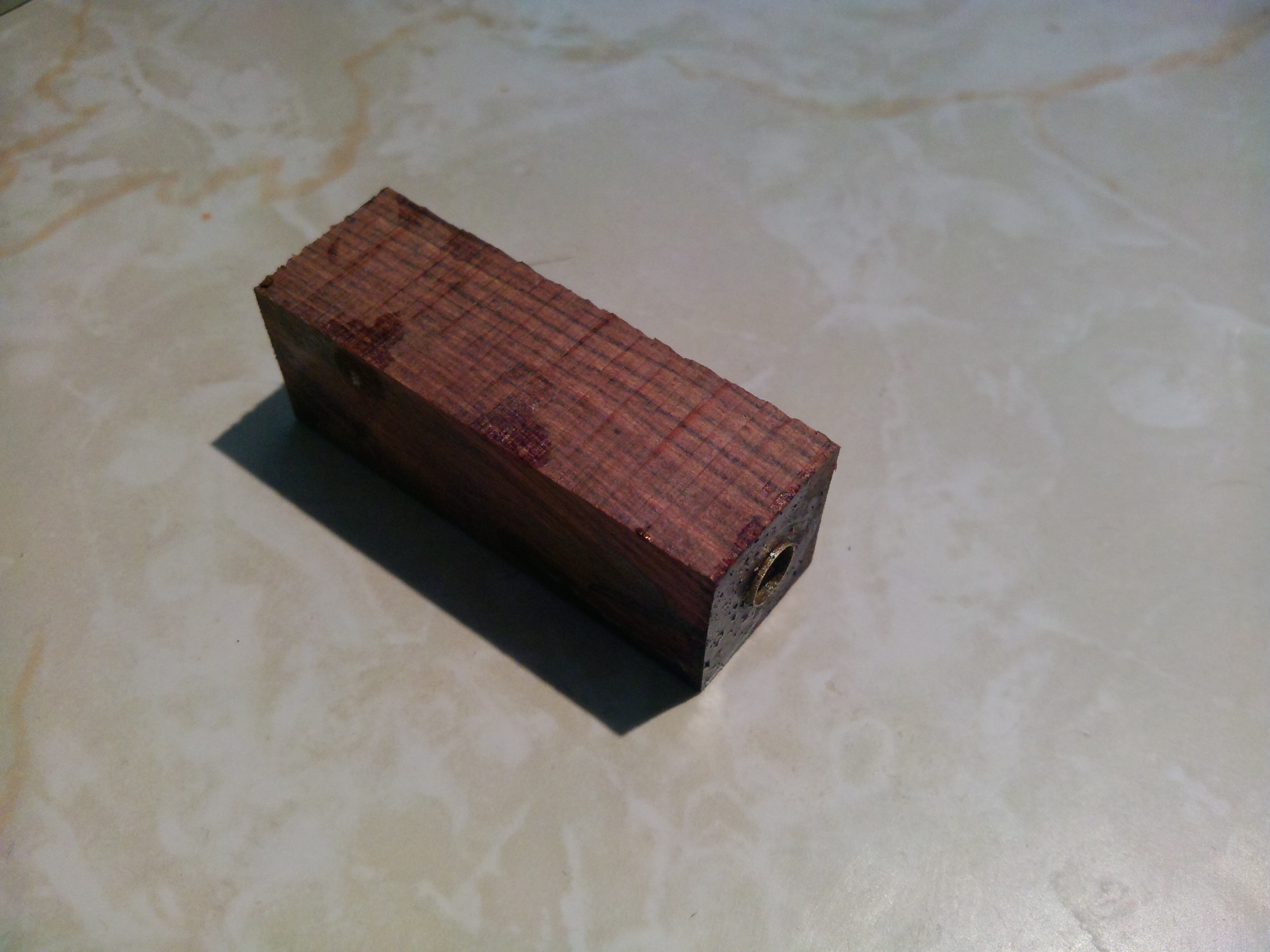
This blank is now unusable. Using epoxy gives you a better chance of this not happening. As this is the first time that this has happened, I don’t usually worry about this. If you cut your blank well, there should be just a bit of a wood overhang when the tube is set. This is important because the wood and the tube have to be squared off. You do this with a pen mill in the drill press. The pen mill has a shaft that is the same size as the inner diameter of the brass tube. At the top of the shaft, there is a cutter that does the job of squaring the blank. One of the biggest errors made in pen kit failures is an out-of-square tube.
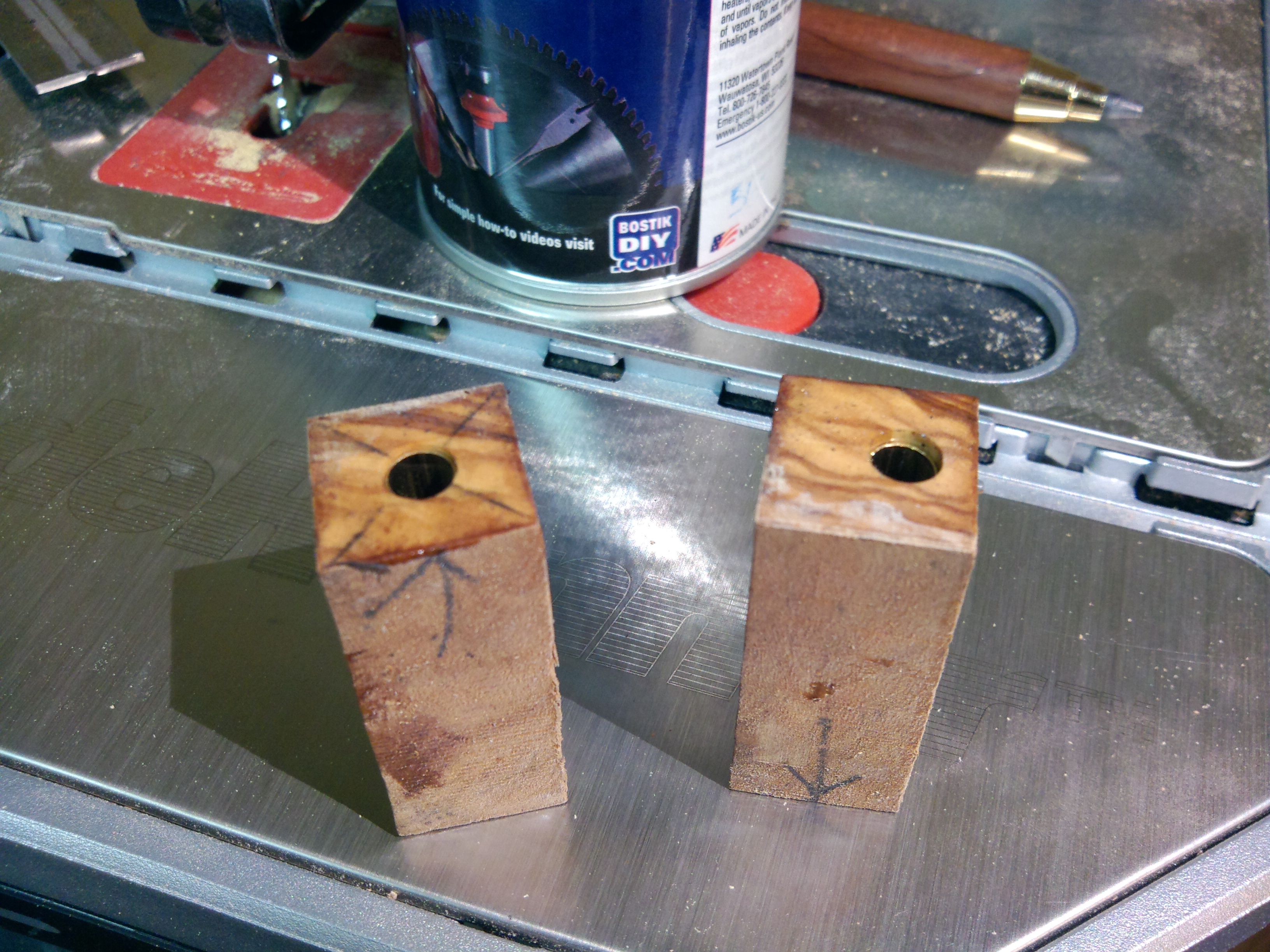
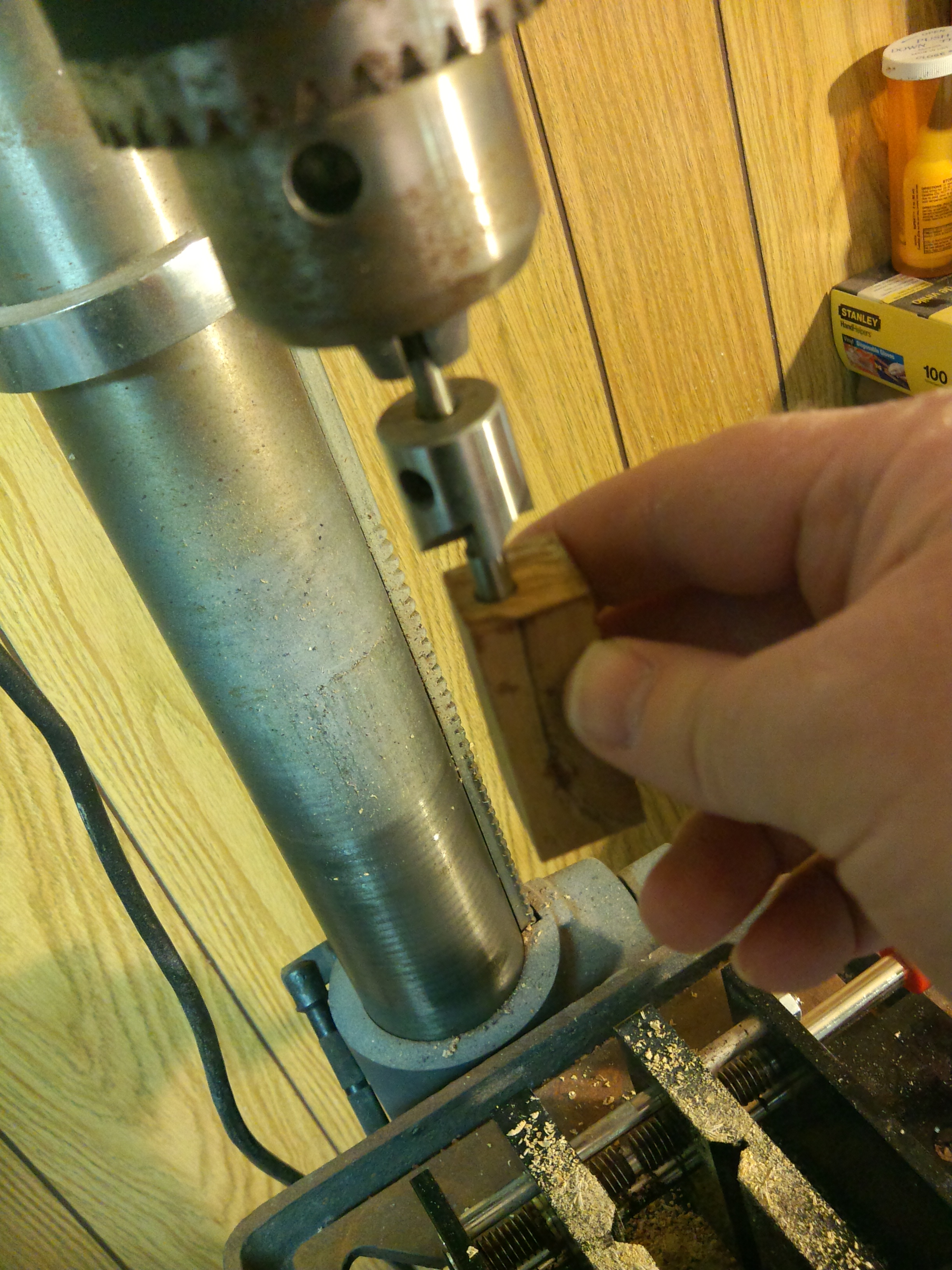
Holding the blank by hand is probably a bit risky, but I am careful… although not careful enough in this case, because I cut my palm at some point during this process. The picture below is the blanks squared off and ready to go on the lathe.
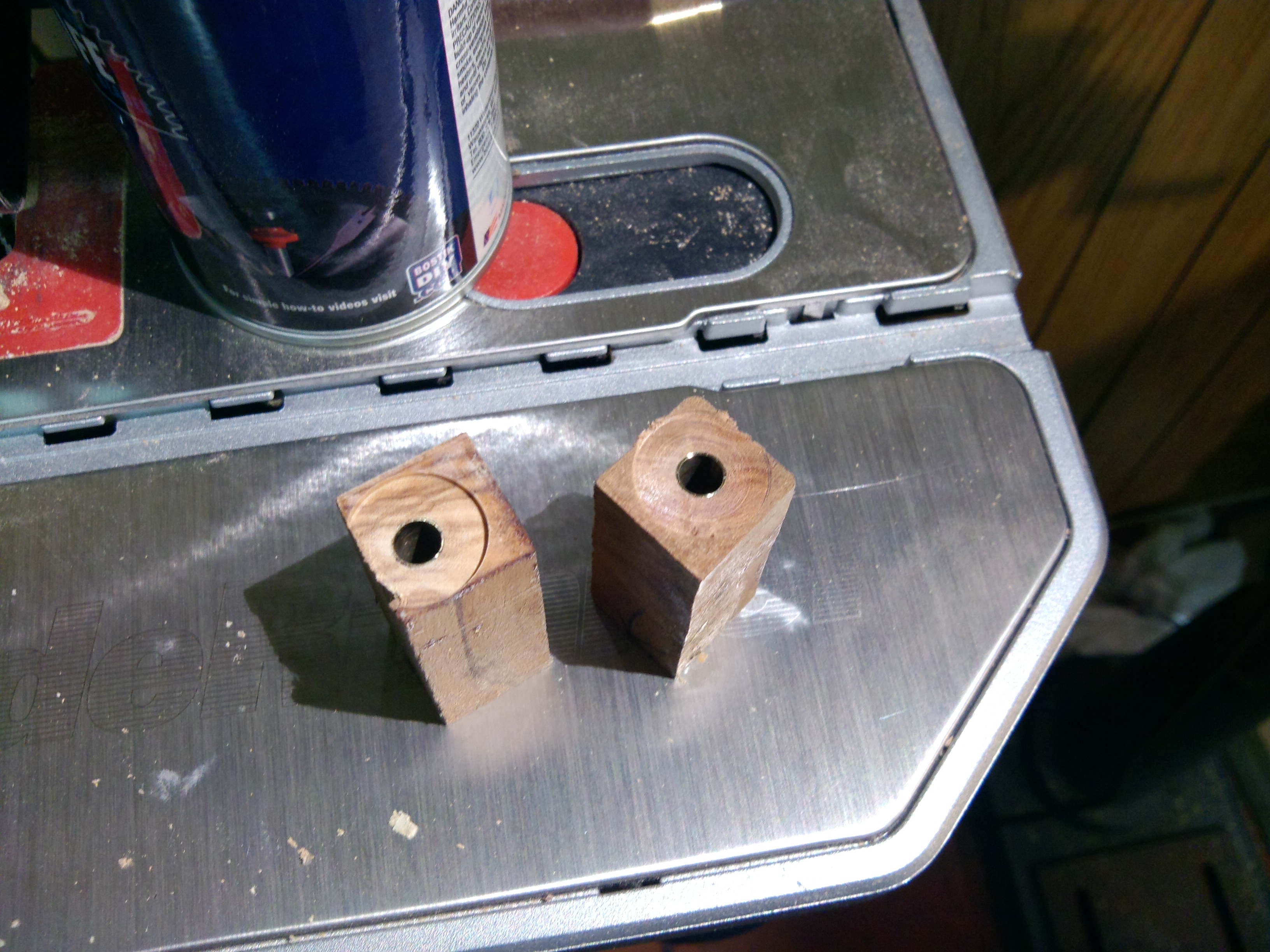
The bit of the blank that is untouched by the cutter will come off in the turning. Not picture here, is the mandrel that the blanks go on. There are bushings that are milled to the pen kit pieces, that these pieces will be turned down to. The kit instructions determine how the blanks go on the mandrel, but I am careful to place them on in the correct orientation (i.e. align the arrows).
To be continued…
 To Everything, Turn...Turn...Turn