I haven’t made a pen with acrylic for quite some time and thought that it was time. I came home sick from work this morning and slept for several hours. When I woke up I was still feeling a bit poorly, so to take my mind off my stomach, I went down into the shop.
This pen is made from a blank from William Wood-Write, called Stonewashed Denim. Last year, I tried to make a pen with another of these and turned too much of the acrylic away. Today I was very careful.
One of the things I learned about these blanks is they are very brittle. I have started drilling the holes on the lathe with a jacob’s chuck in the tail stock. Centre the stock in my scroll chuck, turn it on and the stock spins around the drill bit. This way, the bit doesn’t wander as much as it does in my drill press. An idea, that has taken me far too long to come to realize. Because I am worried about excessive heat blowing out the blank, I have started to drill a small hole through the blank first, and then use my final size drill bit. I started with a 7mm bit and the hole went through beautifully. When I chucked up the 3/8 bit and advanced it, when it bit into the blank, it tore out about 1/8 inch of the blank leaving a very rough hole. The remainder was fine and fortunately, I had not cut the blank to length (another idea that I have been trying), so I was able to cut off the chipped out portion of the blank before sizing the final length and cutting.
Another realization occurred when I was squaring the blanks on my segmented pens. Up until this week, I had been chucking my pen mill into my drill press and then holding the blank and manually pushing the stock onto the cutter. The other day, I thought, “Hey… this is a drill press” and so I put the blank in the drilling vice and lowered the mill onto the blank. No more slivers or cut palms. My only concern is the pin on the mill. They wobble a bit and there is quite a lot of side to side movement of the top of the blank. My solution to that is to have a smaller pin that is free to move around in the tube.
Once squared and on the lathe I was able to start turning. I have mentioned before that these blanks have two very different densities of acrylic. The white ribbons are quite a bit softer than the blue and so you have to be very careful to not gouge the blank at the ribbons. Use a very light touch on the cutting. It takes longer to do the turning but it is worth it to have a nice smooth blank. Acrylic also has to spin at a much faster speed because you want to cut the acrylic with your knife instead of melting it. I had the lathe turning at 2750 rpms and could probably have gone a little faster as the heat was melting the shaving as it was leaving the blank. It seems to me that 2000 rpm was the recommended speed, but it could have been 3000. I don’t remember from my class. This is a bit of research that I will have to do. My lathe maxes out at about 3200 rpms so I hope it doesn’t need to go faster than that.
This is, once again, a Longwood Click style pen.
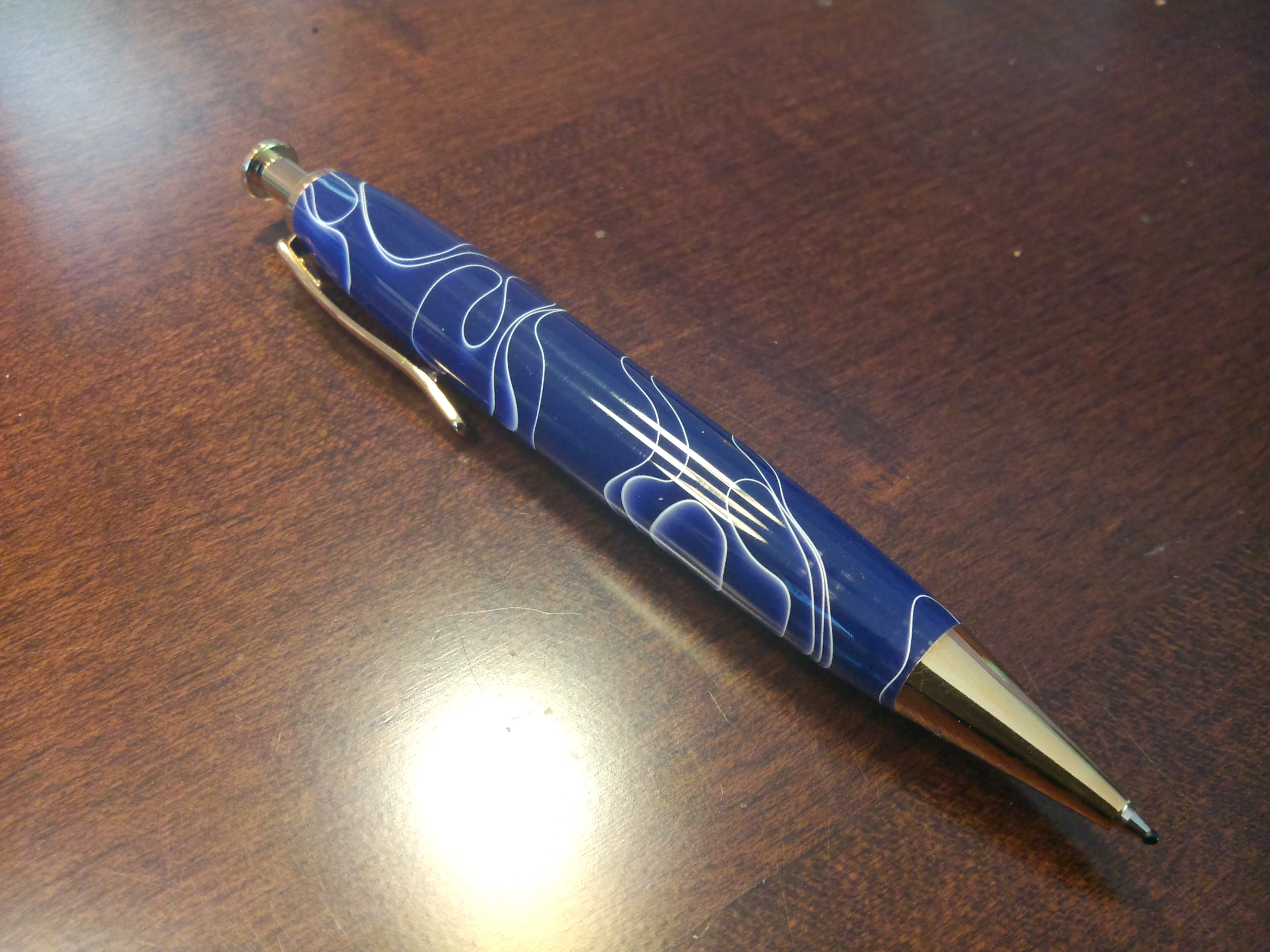
Once turned, I sanded with a piece of wet 600 grit sandpaper (I had some chatter marks from my scraper). In my class I was told to use a Bastard File to remove tool marks so this was a bit of an experiment. An experiment that worked quite well. After the 600 grit sandpaper, I moved to my wet micromesh sanding pads and moved up the line from 1500 grit to 12000 grit which left a nice polished surface. After the micromesh I polished further with my EEE Cream and then finished off with my Meguiar’s PlastX Plastic polish. Both the EEE Cream and the Meguiar’s uses the same principle that as the heat and friction is generated, the particles break down and sand finer and finer. A beautiful finish.
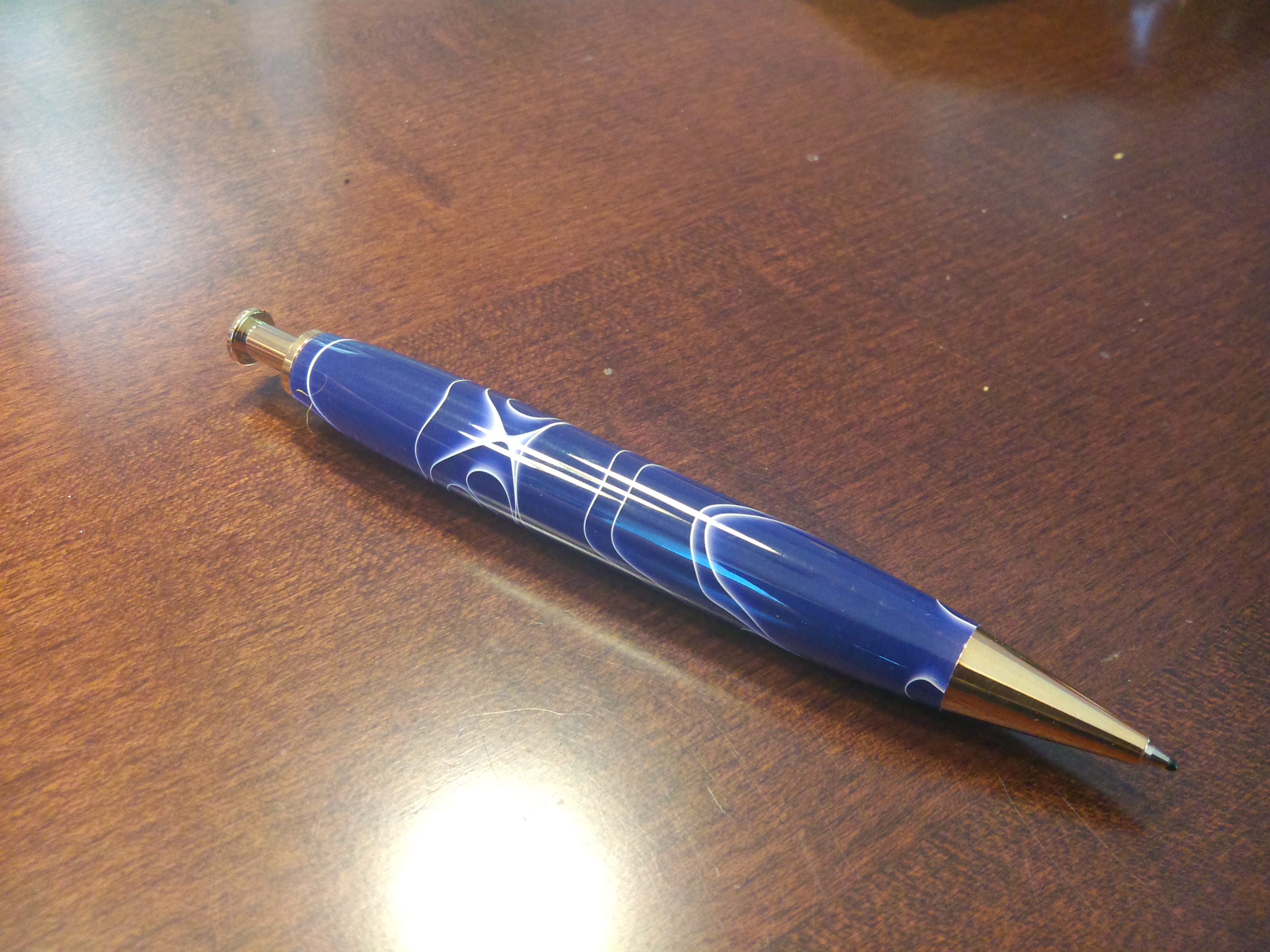
Next non-segmented Longwood that I do will be a little finer. I think more of a straight pen rather than this slightly bulbous look is in order.
 To Everything, Turn...Turn...Turn