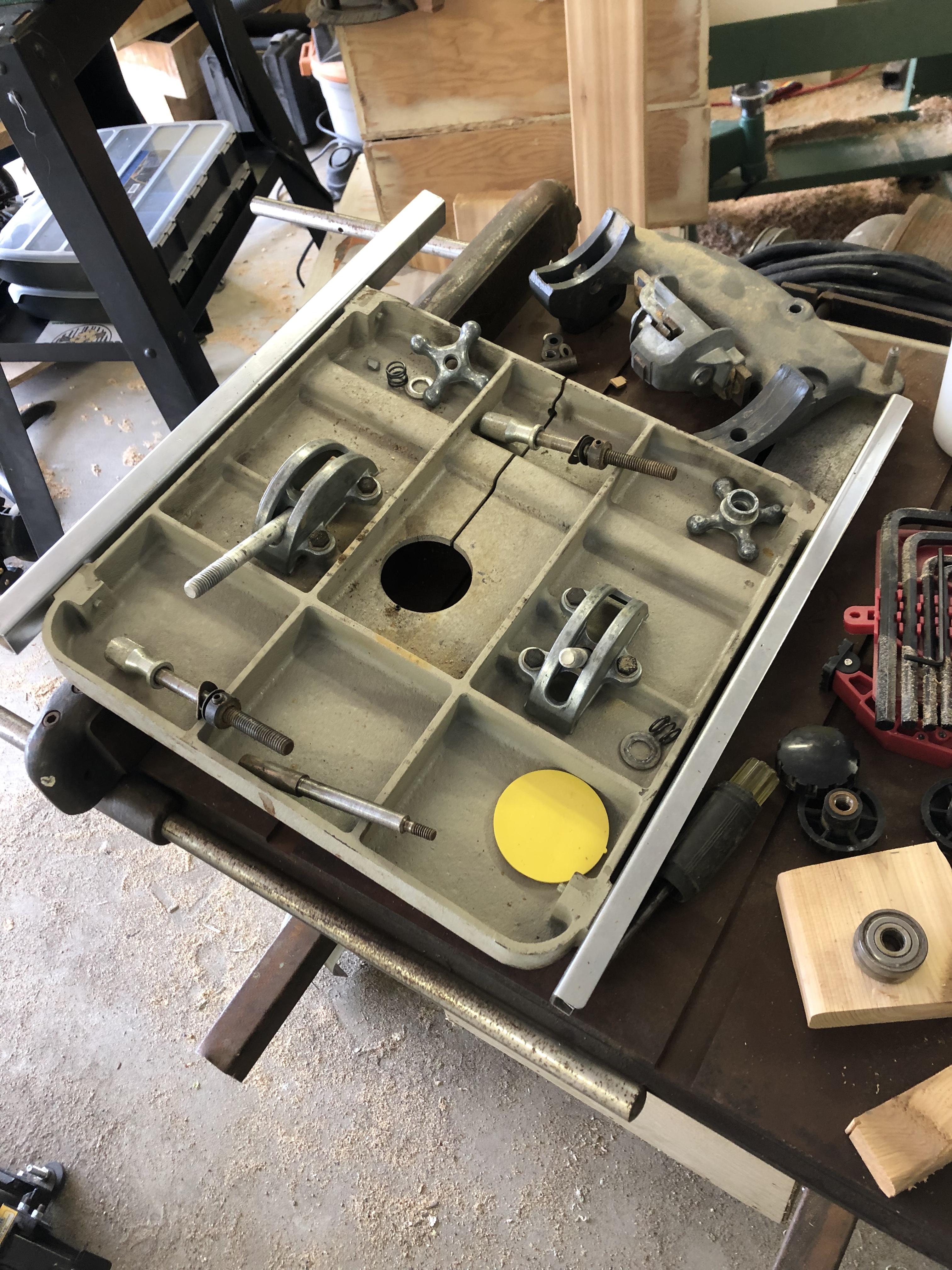
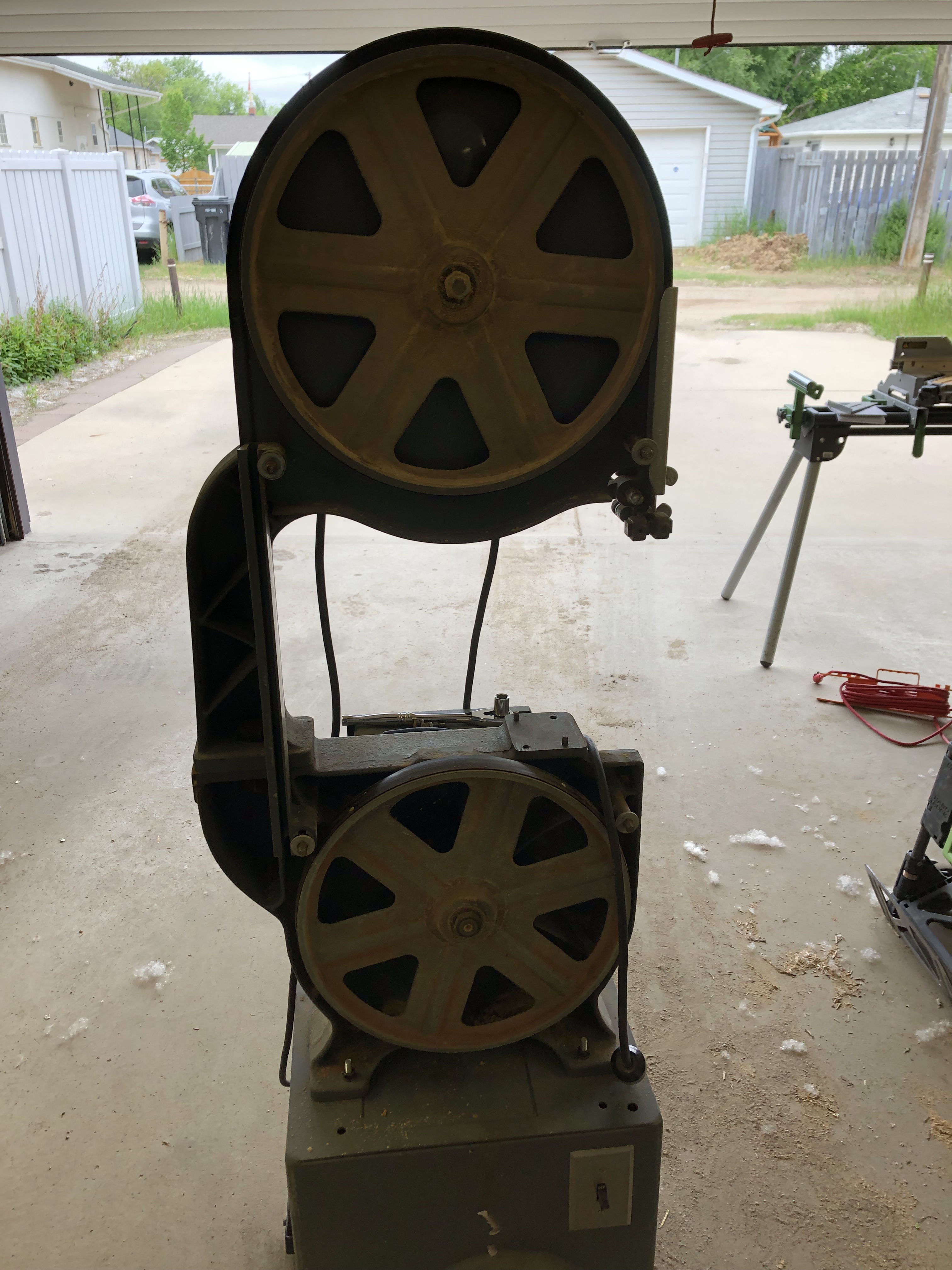
I have always been amazed at the irony of everything that I have to do in order to play with wood. The last few days have been spent trying to get my Tablesaw going after the three year hiatus. It has turned into a bit of a chicken and egg matter. I don’t have have a workbench yet in my new shop, which means I don’t have much in the way of worktops. I have my little Black and Decker Workmate set up, but my tablesaw has become a work surface and catch-all while I do some turning. Last week was the week for a tune-up of my bandsaw. I pulled the table off, cleaned it, replaced the tires and guide bearings and put a new blade and link belt on it. (Here is a picture of it pulled apart… and I didn’t have any parts left over when it went back together). You will note that the parts are sitting on my Tablesaw.
Now… onto my tablesaw. I should let you know a little of the history of my saw. It is a little Beaver 3200 and dates from the mid 1950s. The base and tabletop are made from heavy cast-iron and it is on a tube steel frame that someone made for the saw. The motor is a Leland Electric 3/4 hp motor that weighs close to 100 lbs, which leads me to this tune-up. For a few years now I have been struggling to start the saw. I discovered that there was an arm that needed to be close to a moving ring in order for it to start. I would open up the motor bell housing and push the arm, then startup the motor and make my cut, shutoff the saw, pushed the arm, started the saw… and so on. It has been a bit of a pain. Before I fired it up in my new shop, I thought I would resolve that issue once and for all. Little did I know that it would lead me down a giant rabbit hole.
The motor is called a Repulsion/Induction motor. As the speed comes up, the centrifugal switch pulls away from the rotor which spins within the stator and effectively short circuits the startup switch. When the saw is turned off and the speed comes down, the centrifugal switch returns to its startup position… in theory. My switch is broken which means that while it can start, there is no “hook” on the switch anymore that wraps around the “necklace” or switch pieces. There were some advantages to this type of motor. Their electrical draw was less while up to speed and R/I motors had more torque. My saw has been in operation for almost 80 years and this is the first thing that has gone wrong. At any rate, I have pulled the motor off the saw and am preparing to install a new motor. It’s only a 1/2 horse so I hope there is enough power in it, but it is substantially smaller.
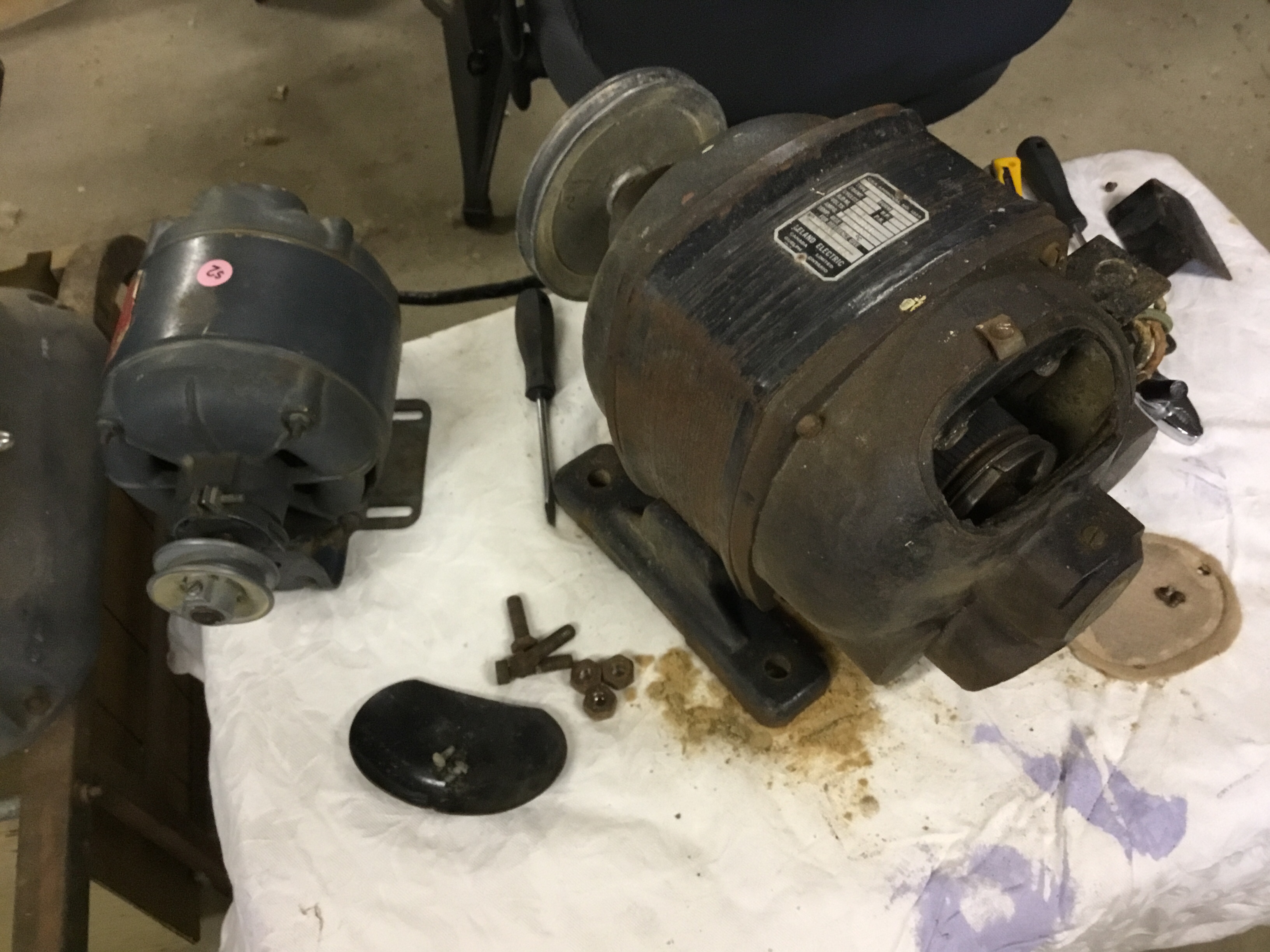
Not sure if the little one will work, but I have to make some electrical connections and some modifications to the mounting plate, which means drilling through 1/4 inch steel. Nothing happens quickly because I am not exactly setup for metalworking. Ah well… the saw will be worth it.
 To Everything, Turn...Turn...Turn