To Everything, Turn…Turn…Turn

Alan's Turning Log – Adventures in Wood Turning

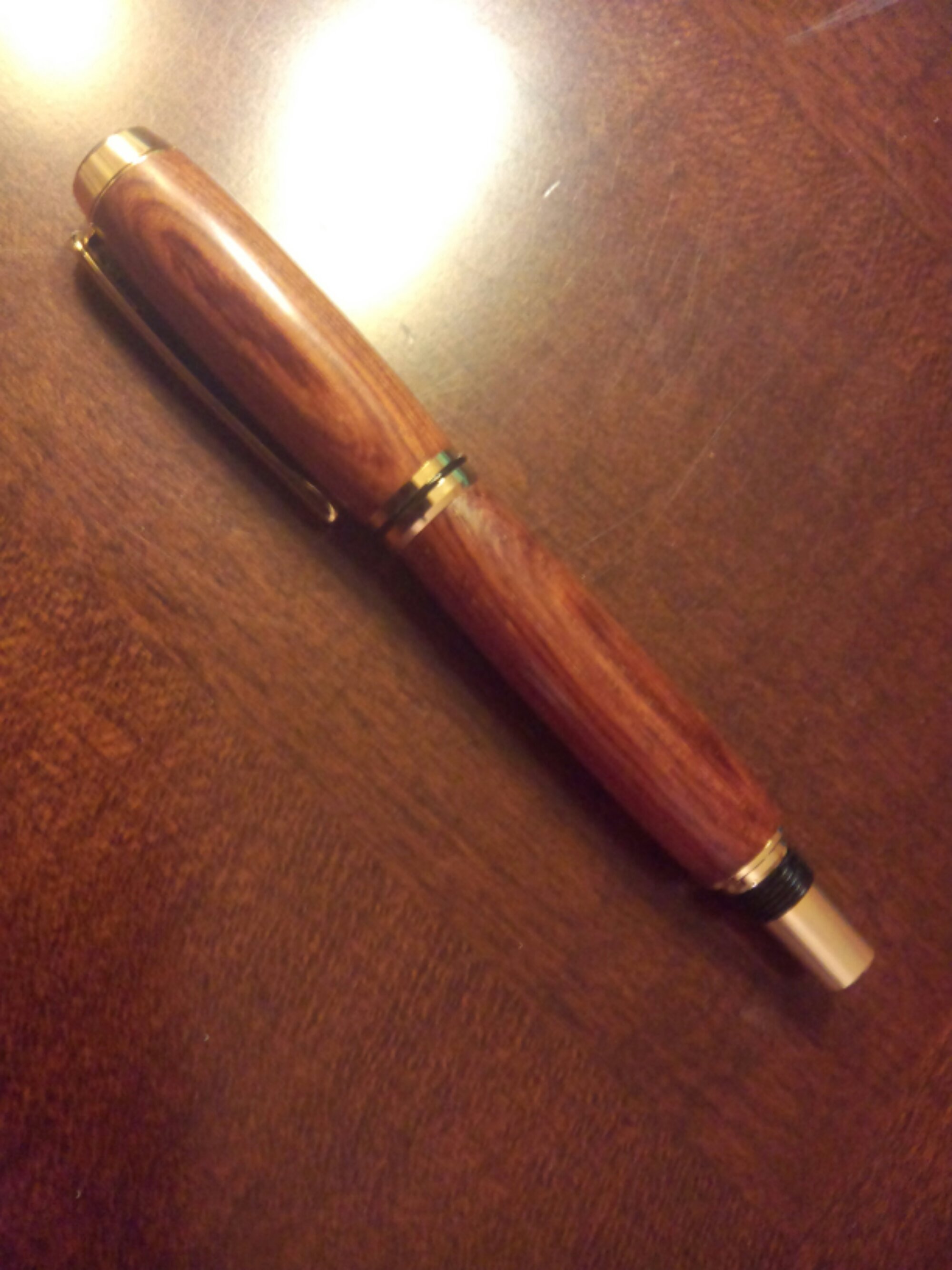
  • Another frustrating day in the shop today.  I think I was preoccupied and failed to pay attention as I was trying to make a new pen.  The last Purpleheart Baron Fountain pen that I made ended up with blotches in the finish and I was sick and tired of looking at it.  I  started out with my last Honduras Rosewood Blank but when I drilled the short blank, It split at the lower end.  Then I cut my last purpleheart blank, but wasn’t paying attention when I was drilling the blank.  The Baron tubes are two different sizes, but I started to drill the long blank with the short blank drill bit, so I had to start over again.  I found a Mun Ebony blank and decided that would do.

    The Mun Ebony is a beautiful wood.  Not very dark at all and a beautiful grain when turned down.
    image

    After turning the blank, I finished to 1500 grit and then “buffed” the blanks with some of the shavings.  This tends to clean the blank out and fills in exposed pores with some micro shavings.  Before I applied the final finish, I cleaned the blank with some rubbing alcohol, and then applied the EEE Cream.  Once the EEE Cream was cleaned off, I had a wonderful smooth pen blank.  The final step in the finishing was a new wax called Shellawax.  It is a shellac based finish that takes approx 3 weeks to fully cure, but they encourage use during the curing time.

    image

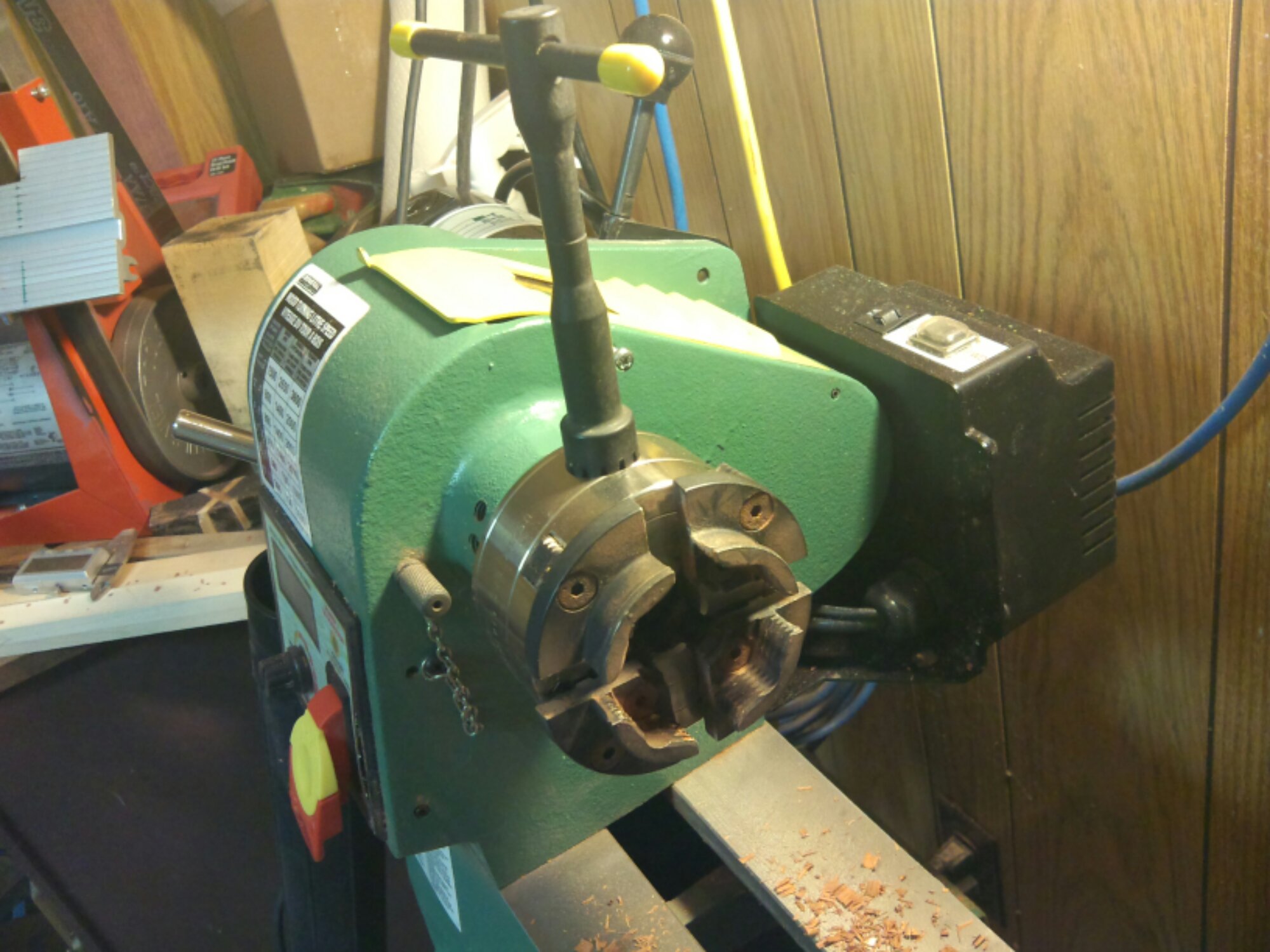
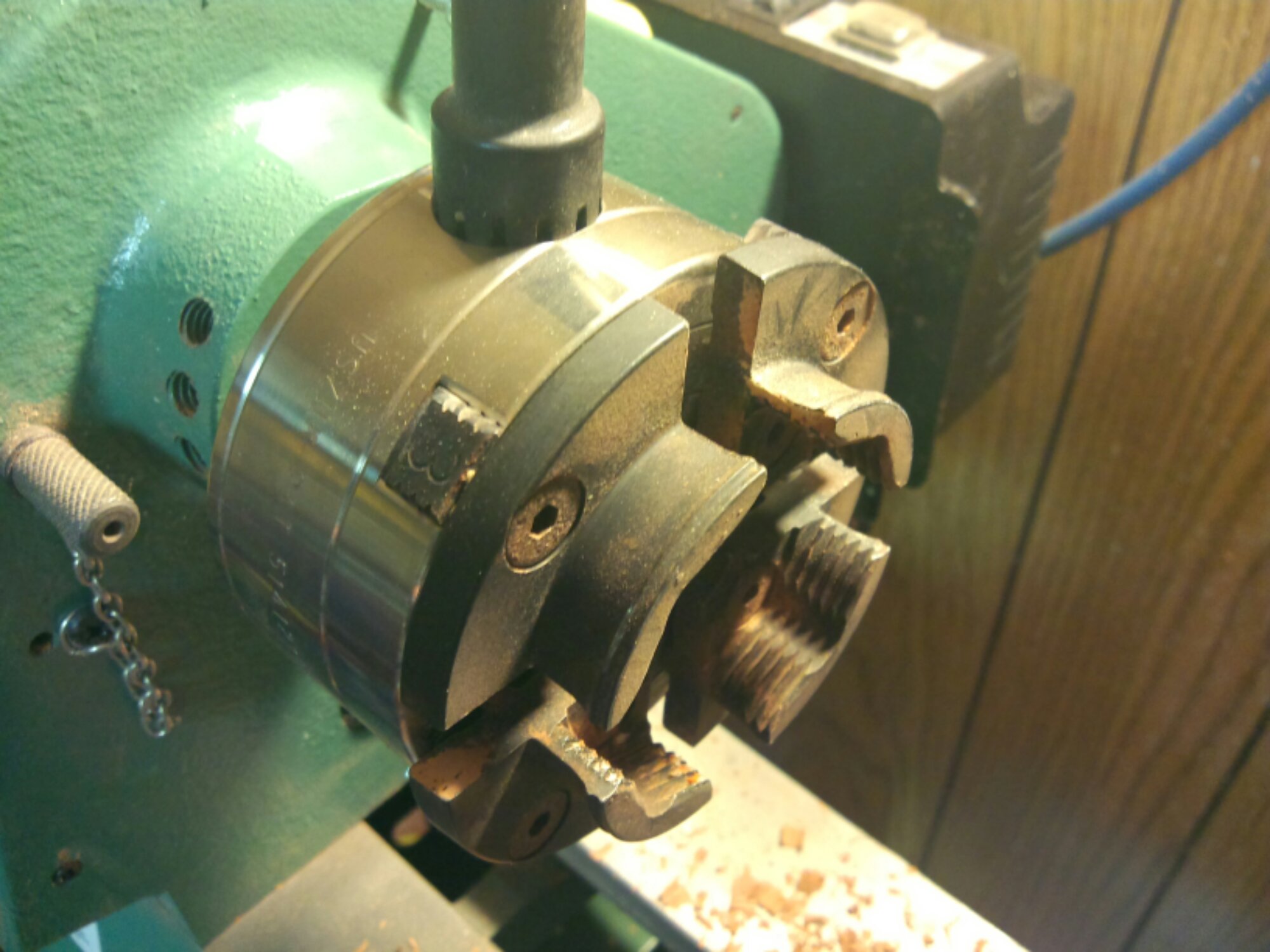
  • One of the best advances in wood turning has come from the world of metalworking in the self centreing jaw chuck.  There are certainly ways to make anything on the wood lathe without a scroll chuck, but this speeds up many of the processes dramatically.  When I purchased my lathe almost a year ago, I couldn’t really afford a scroll chuck and so it went on my “wish list”.  In January, I was asked to conduct a couple of band rehearsals for a local community band and they paid me for the rehearsals.  As it was “found money”, so to speak, I decided that I could finally make this purchase.

    image

    This is called a scroll chuck because there is a scroll beneath the jaws that moves all the jaws in or out at once when the chuck is tightened or loosened.  The jaws are interchangeable and come in different sizes and designs for different pieces.  This chuck is a Talon Chuck made by Oneway in Ontario.  Oneway makes a fine line of lathes and accessories for wood turners.  The Oneway lathes are among the highest rated lathes on the market at present as are the Oneway chucks.  These chucks have a rather unique jaw design that grips the workpiece very securely.  The Talon has a chuck key and can be tightened with one hand while I am holding the piece in the other.  Oneway also has a Basic chuck that uses two bars in a lever action to tighten the jaws.  It is another approach that turners seem to like.  I chose the Talon because of the key system and the fact that it is only a few dollars more than the basic chuck.

    image

    The project that I am starting to plan is a wine goblet.  I have been having problems with end-grain turning and will need to practice and sharpen my tools a bit better.  I still seem to be catching the gouge an awful lot and need to refine my technique.  I suppose that another marathon YouTube session is in order to see if I can pick up any helpful hints.

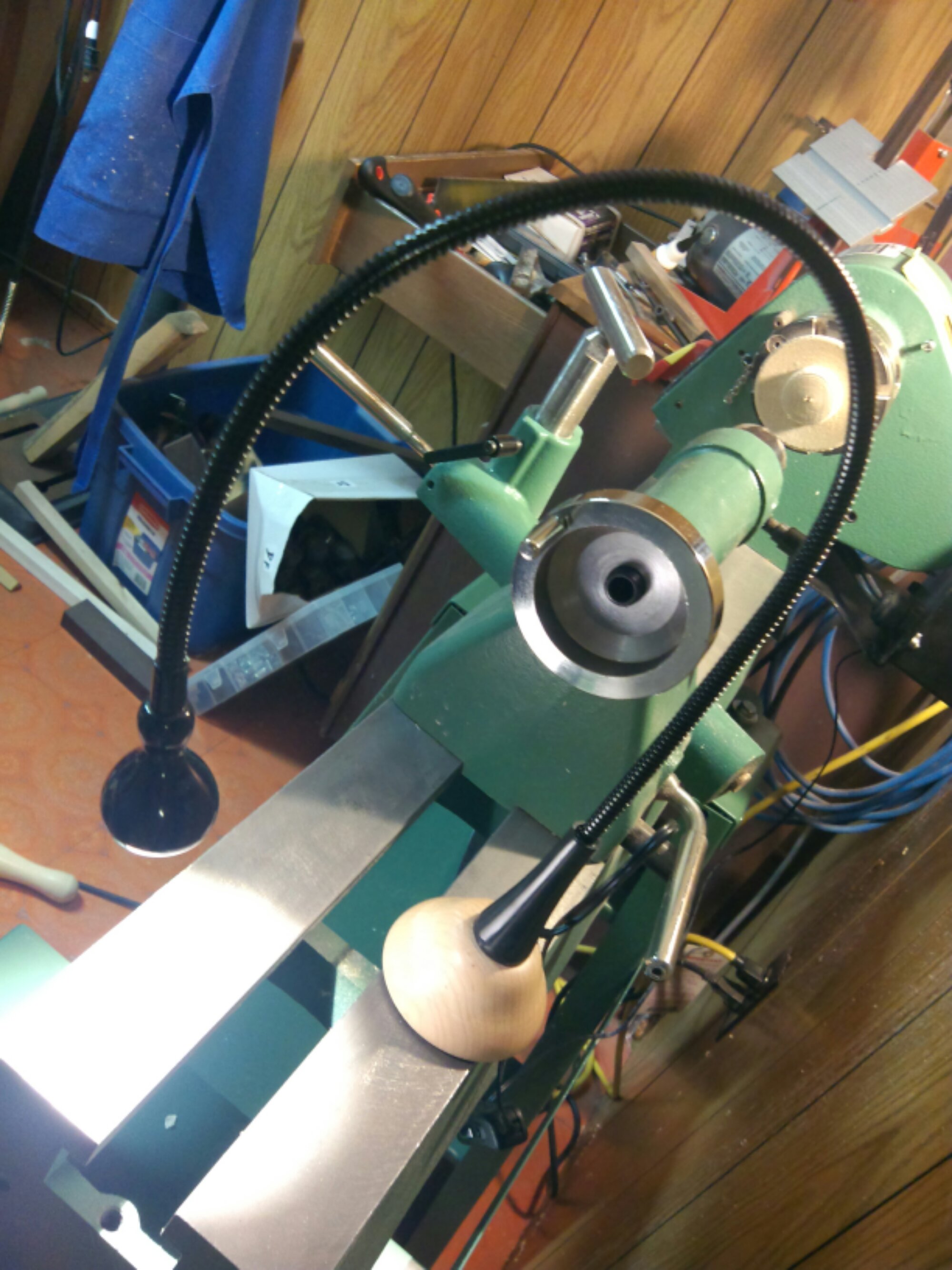
  • I got this idea (actually I tried to duplicate/steal the project) from Alan Stratton who has a YouTube Channel called AsWoodTurns. Since I purchased my lathe and placed it in the shop in the basement, I have struggled with how to light the work area adequately.  I have a 4 foot flourescent in the room, but I block the light as I stand between the light and the lathe.  As a “temporary” fix, I hung a trouble light on a hook on the wall above the lathe.  The only reason I don’t like that is that half the time when I look up, I get blinded by staring into a bare bulb.  I have been looking for a light fixture that I could suspend on the ceiling over the lathe (much like a bathroom light fixture) and thought I would make one, I just haven’t found the right design.  I have numerous puck lights from Ikea and thought that I would use those. 

    Anyway, before I bought my lathe I saw Alan’s video and thought that these lights would be perfect (at least to direct light exactly where it’s needed).

    image

    I picked up 2 of them from Ikea ($11.99 each) and they have sat in my shop for almost a year.  I tried to figure out a way to make them early on as I hoped they would be my first projects on the lathe, but I couldn’t figure out how to make them without a scroll chuck.  Now that I have a newly acquired scroll chuck I decided that there is no time like the present.

    image

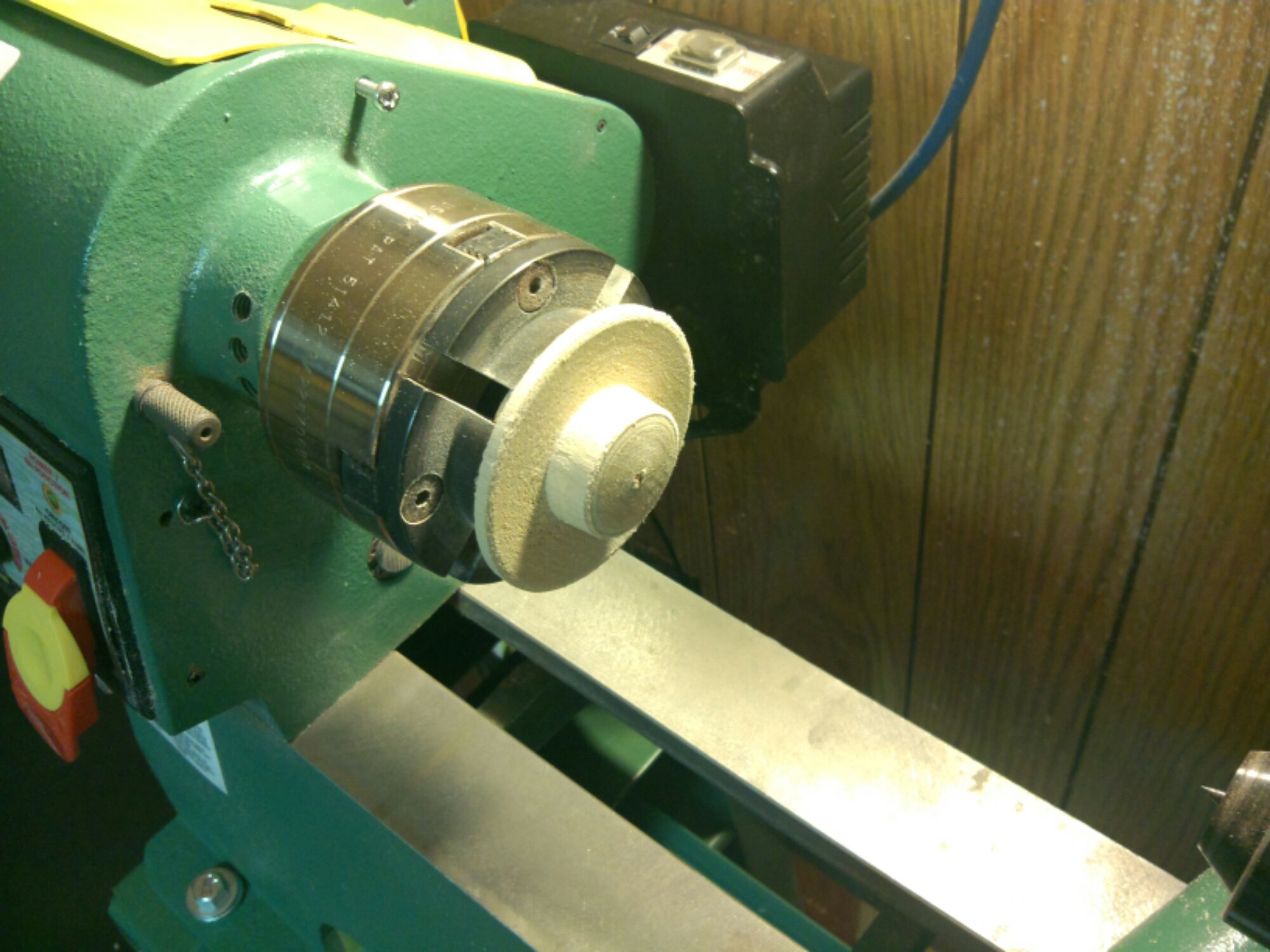
    I had to utilize some of my own puny brainpower to do them but learned a few new techniques.  I watched Alan’s video before I started but several points were not clear, so I just started and adapted as I went along.  The first thing I did was true up a piece of Maple between centres and turned a tenon so that I could chuck it in the scroll chuck.  Before I chucked it up, I drilled two holes for the pins on the bottom of the light.  I didn’t quite get them centred on either side of the centre, but I don’t really notice.  Next, I chucked it in my Talon and turned another tenon on the other end.  This was somewhat pointless as I could have used the first tenon as the top, but wasn’t thinking clearly.  Once chucked on the Talon, I cut the recess in piece for the magnet that attaches to the bottom.  Then I had to drill a larger hole to countersink the screw and washer on the end of the posts so that I could actually attach the magnet.  Then I flipped the piece over to shape the top.  In Alan’s video, he used longneck (?) jaws in his chuck to expand into the magnet recess.  My magnet was too small to have my jaws do that, so I made my first jamchuck (below) that held the piece in place while I was finishing the top.

    image

    The pin you see here was a snug fit on the recess.  This worked perfectly and I will use it for my next one as well.  All in all it was a good afternoon in the shop.  I finish sanded to 420 grit and then used the EEE Cream.  As it is a shop item, I don’t really think it is important to put a premium finish on it.

    For the next one, I won’t turn a tenon on both sides and I will be more careful about centering the posts between the centres.  I will also attach the magnet before I apply the teflon cover on the magnet which prevents scratches on the metal.  Also, because I made the jamchuck to fit the recess, I will have to take some time to ensure that the next recess fits the jamchuck as nicely as this one did.

  • It has been quite some time since I have actually completed something at the lathe.  I have gone down to the shop a few times but didn’t really know what project to start on.

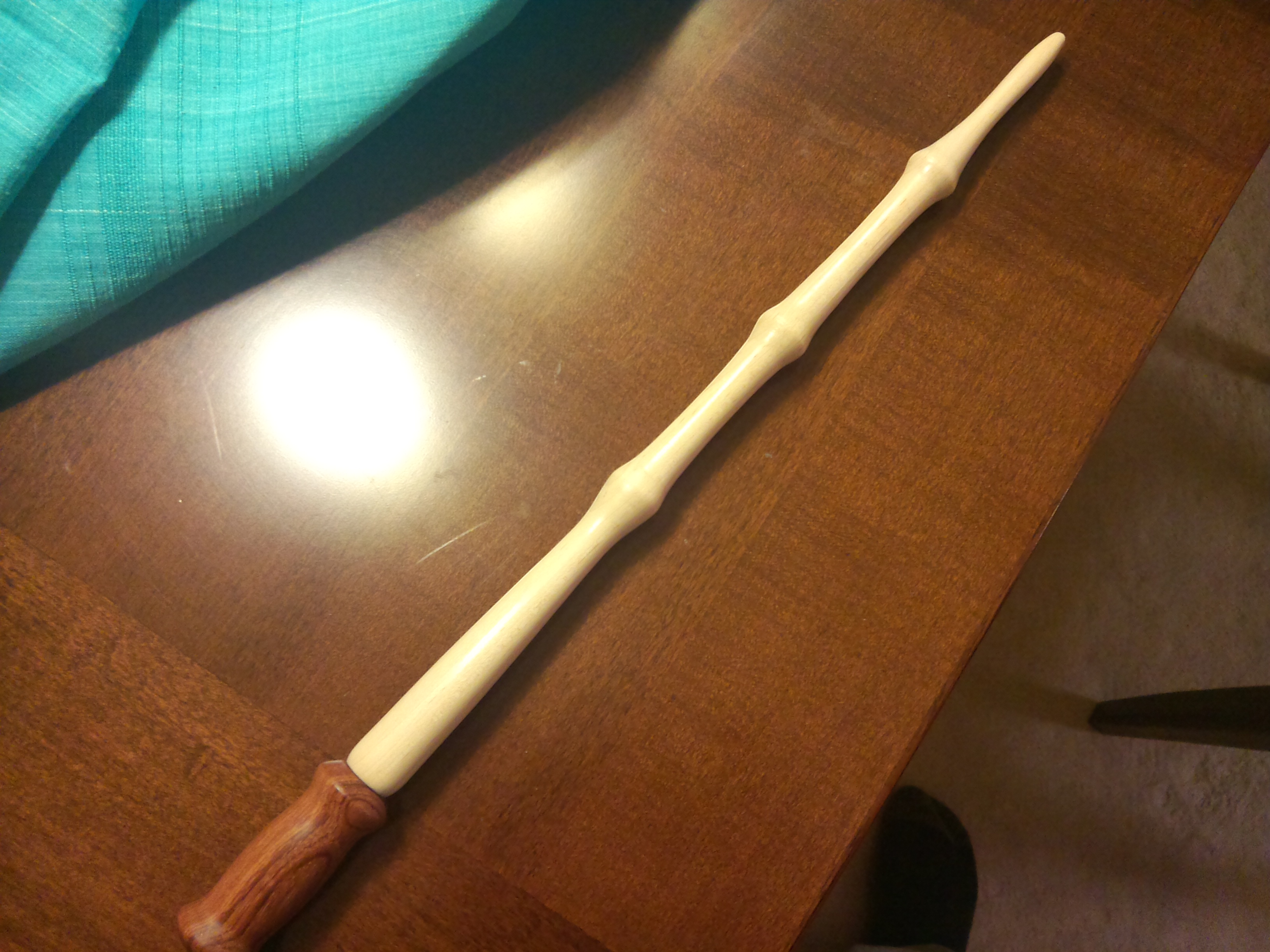
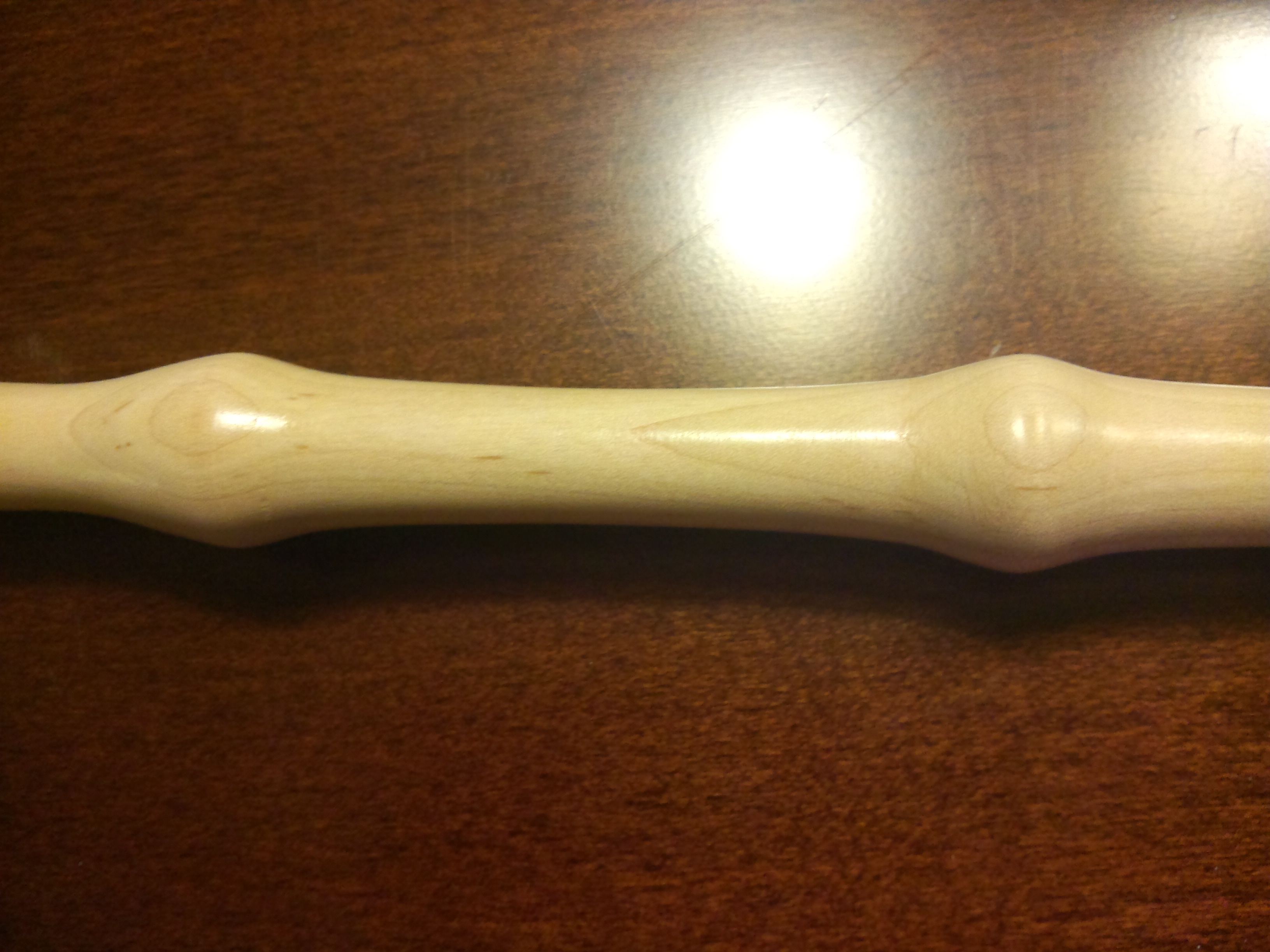
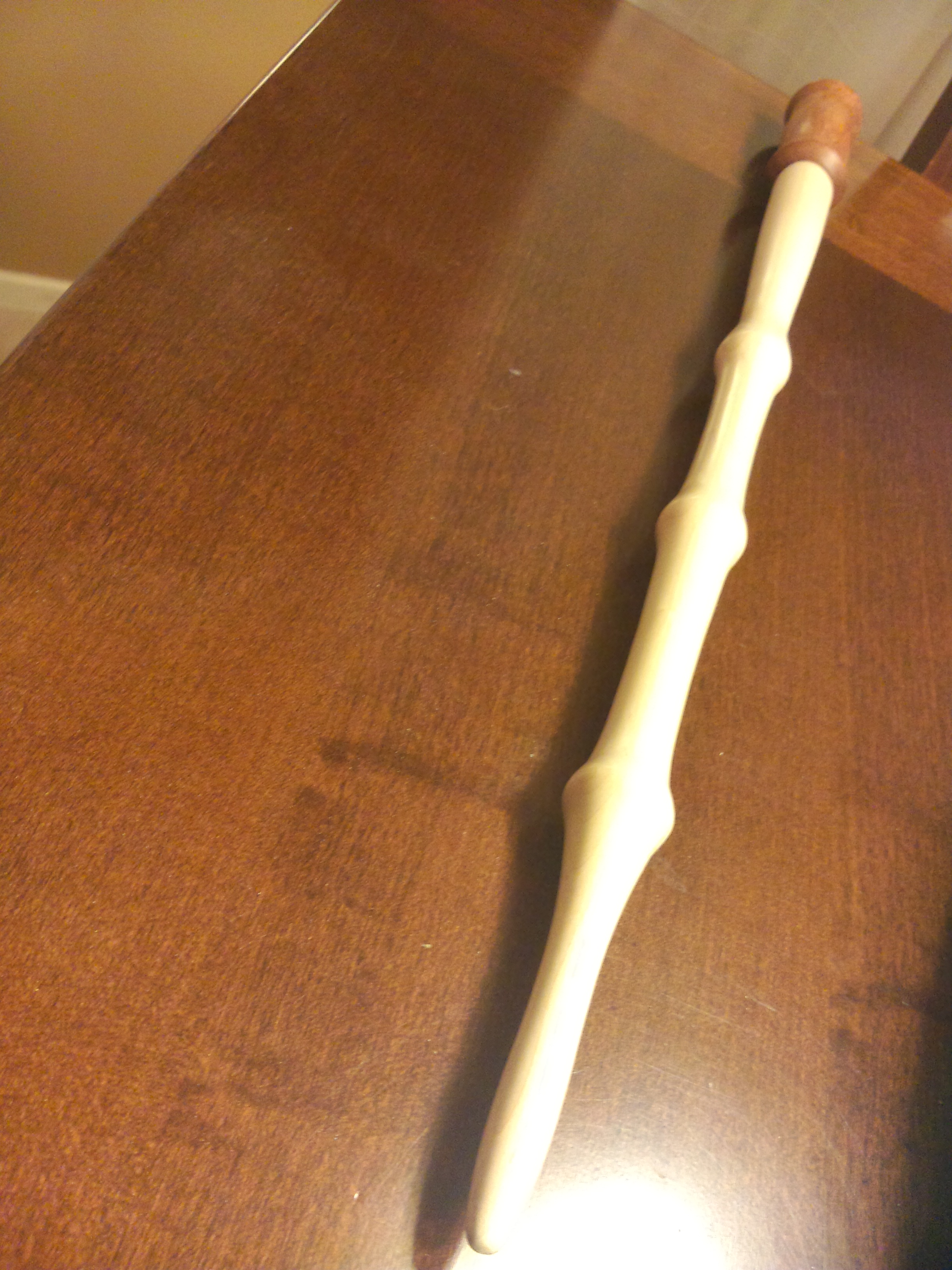
    Last month, a colleague asked If it was possible to turn a Magic Wand in the style of Ollivander’s wands from Harry Potter.  I wasn’t sure what I would come up with, but decided that I would give it a try.

    I was tidying the shop today when I came across a long piece of what I believe is Oak (although it could be ash or maple).  I decided that I would give this “wand thingy” a try.  If it didn’t turn out, at least I would have developed an idea on how I should proceed.

    When I tried to chuck this piece up, I had to start with my tailstock hanging over the end of the ways.  As I cinched up the piece to the spur drive, the tailstock was able to fully sit on the ways.  So… I guess I know how long I can turn on my lathe.

    Because the spindle is so long, I had to hold the piece in the centre with my fingers to keep the wood from wobbling.  Although the wobble produced a neat effect, I couldn’t make the effect consistent and so was careful to get a smooth finish.

    IMG_20140208_195803


    As I was turning the blond wood spindle I realized that the wood was extremely bland, so I decided that I would make a handle from a contrasting wood.  I turned a tenon on the end of the wand and then chucked up a piece of bubinga in my Oneway Talon Scroll Chuck and drilled a hole in the end using my Jacob’s Chuck in the tailstock, after truing up the block.

    After turning and finishing the handle, I inserted the wand into the hole and glued it with CA glue.

    Everything is finish sanded to 420 grit and then waxed with EEE Cream.

    IMG_20140208_195841


    IMG_20140208_195859


    When I do this again, I will make the shaft a little finer (I didn’t want this wand to be readily breakable by a 7 year old).  I will also be a little more precise about the transition for the handle.  In addition, I would like to figure out a way to insert a feather into the wand like the “real” Ollivander Wands.

    IMG_20140208_195941


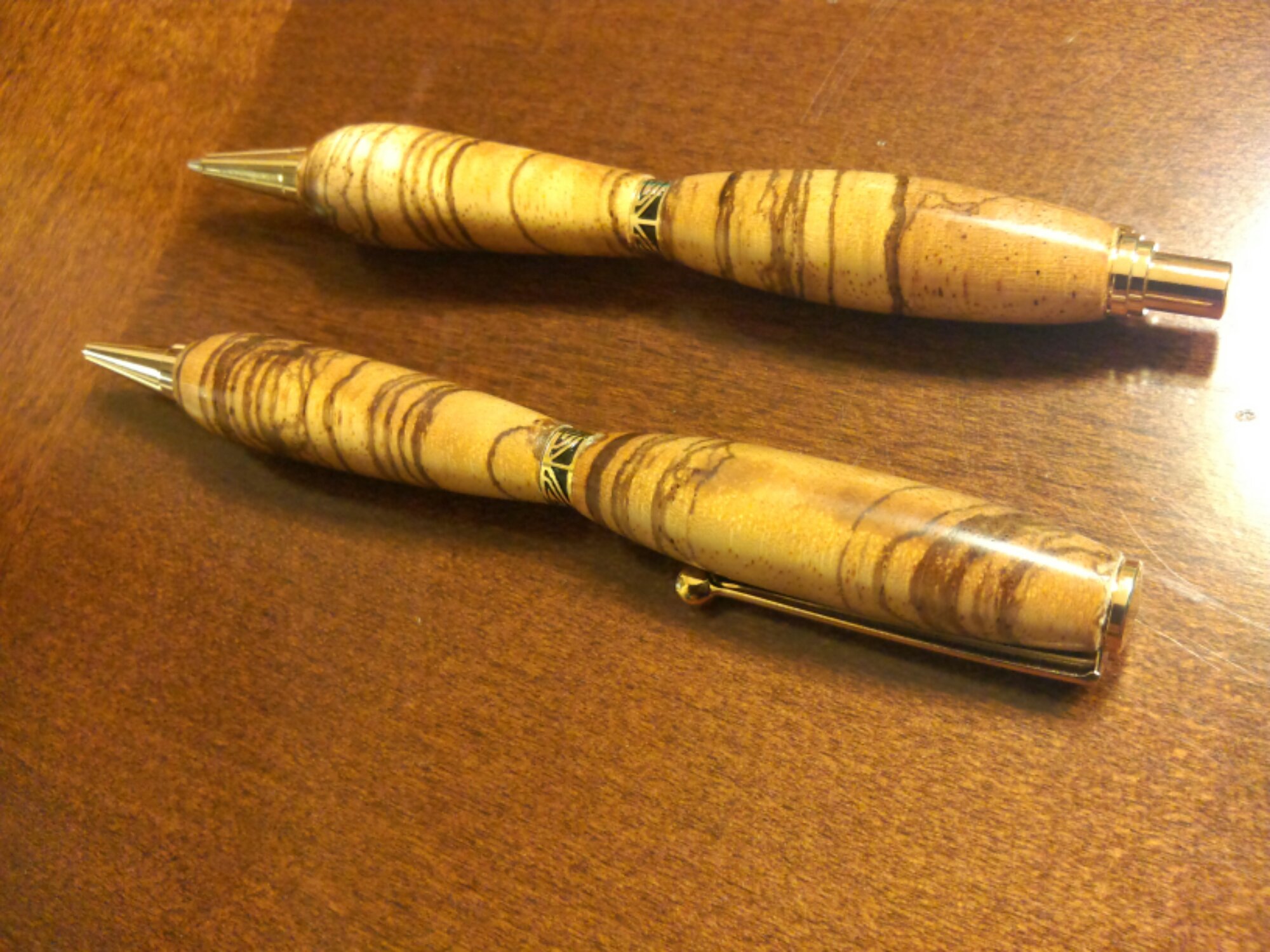
  • A friend gave me a couple of offcuts of Zebrawood from a project that he had done.  By my reckoning, I could get 4 pen blanks out of these pieces.  My niece who ordered the Creamsicle Acrylic, also wanted a pen and pencil in Zebrawood.  I have a book that discusses the dramatically different pens you can get from cutting the blanks at a different angle (in terms of grain direction).  This book specifically shows Zebrawood as an example and so I thought that I woud try cutting across the grain to create a pen and pencil that is not normally seen.  I have a Zebrawood Conductors baton where the dark lines run parallel to the turning.  Now I understand why.

    This wood is extremely difficult to turn cleanly, especially cross grain in this way.  At the ends of the pen tubes, the wood kept tearing out, exposing the brass of the tube.  I decided that I would attempt to make repairs to these spots using shavings and CA glue.  I also didn’t realize at the time that there was a nail hole in one of the blanks and so I thought that I would fill that as well.  I was quite happy with the repairs and went back to turning the pieces when one of the tubes split in half.  Usually, when this happens, the pieces fly around the room, but this time the single piece landed on the ways of the lathe and so I thought I would see if I could glue it back on and finish the pen.  The piece fit cleanly back on the pen and I was able to gently finish turning it.

    Because of all the repairs made with CA, I decided that I should finish the pen in CA as well.  On one of the forums that I read regularly, a fellow pen-turner (one much better than I), shared his method of CA finishing.  I followed it to the letter and can now see a time where I will start to achieve the excellent results that he gets when using CA.  These are still not perfect, but for the first time, I was able to have a nice consistent finish with no dull blotches.  Overall, it was a great experiment.  See if you can identify the repairs in the pictures.
    image

    image

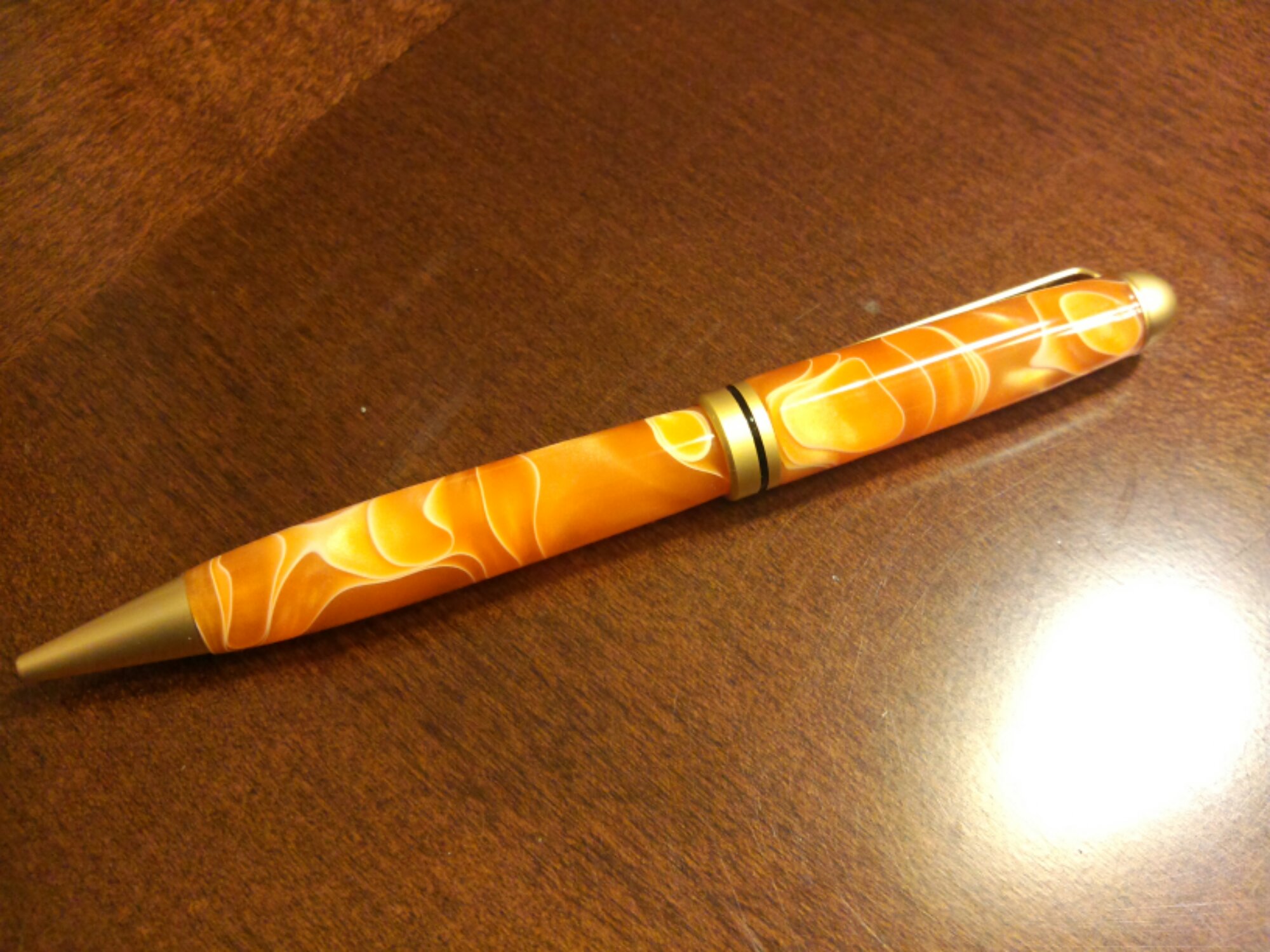
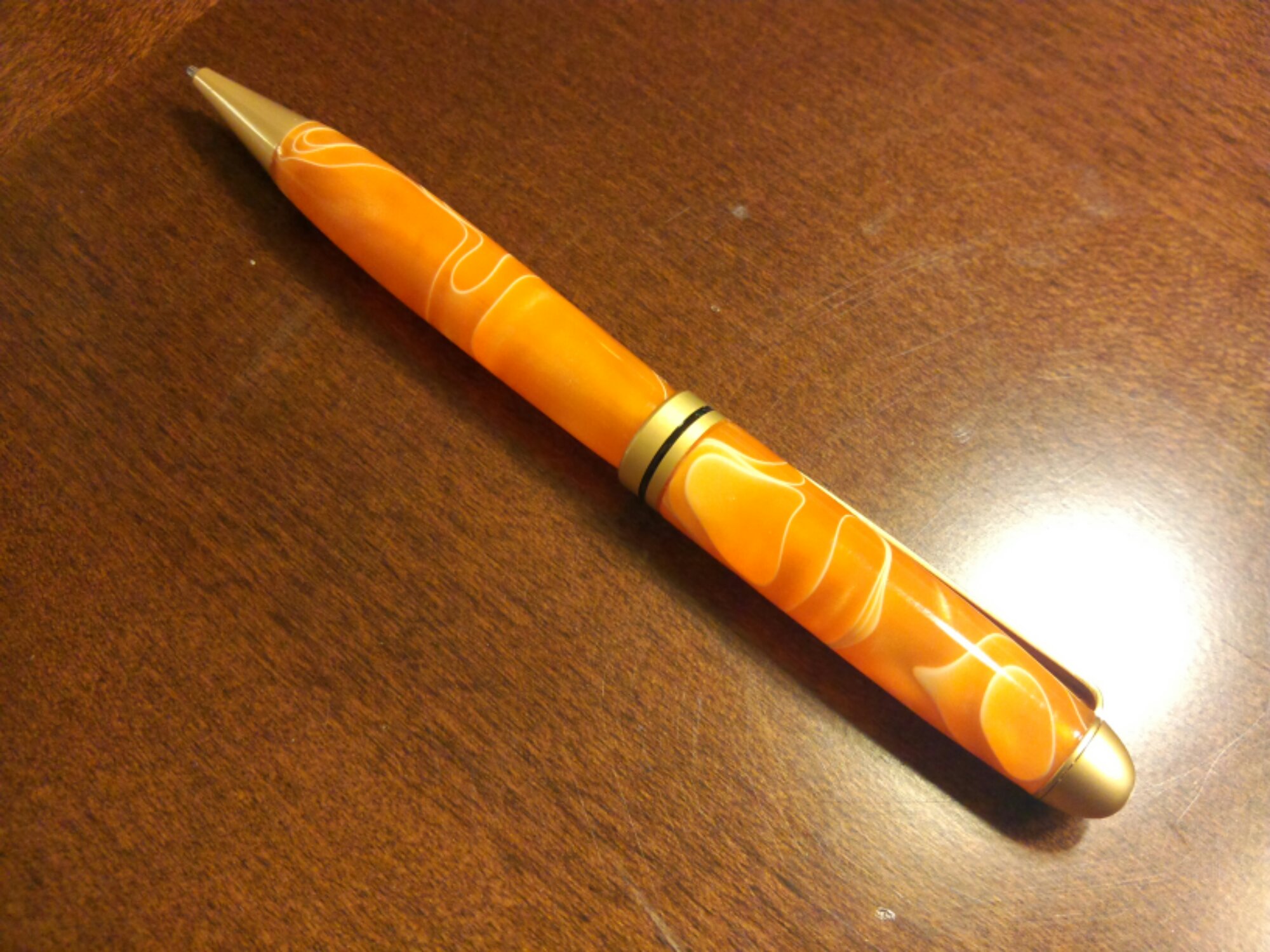
  • One of my favourite types of acrylic blanks which came from William Wood-Write are cast in several steps.  First; ribbons are made and placed in a form in a haphazard way and then multiple colours of acrylic are then poured over the ribbons to give this very unique pen blank.  This particular blank is called “Creamsicle” for obvious reasons (White ribbons and VERY Orange resin).  Makes a unique pen.  This was done in a European Round Top in a Satin Gold finish..  I made this to order for my niece Tina.  I hope she likes it.

    image

    There is a difficult aspect to these blanks that I have noticed.  The different colours in the blanks have slightly different densities and so care must be taken to get an even line in the turning.  It is very easy to turn ridges because some of the parts of the blank are softer than others.  If you take your time though, they turn out beautifully.  I also took time and used calipers to turn the blank to precise diameters, which was well worth the extra time as the kit fit together really well.  After turning I used a EEE cream to “cut” the tool marks out of the blank and then finished with wet Micro-Mesh pads. 
    image

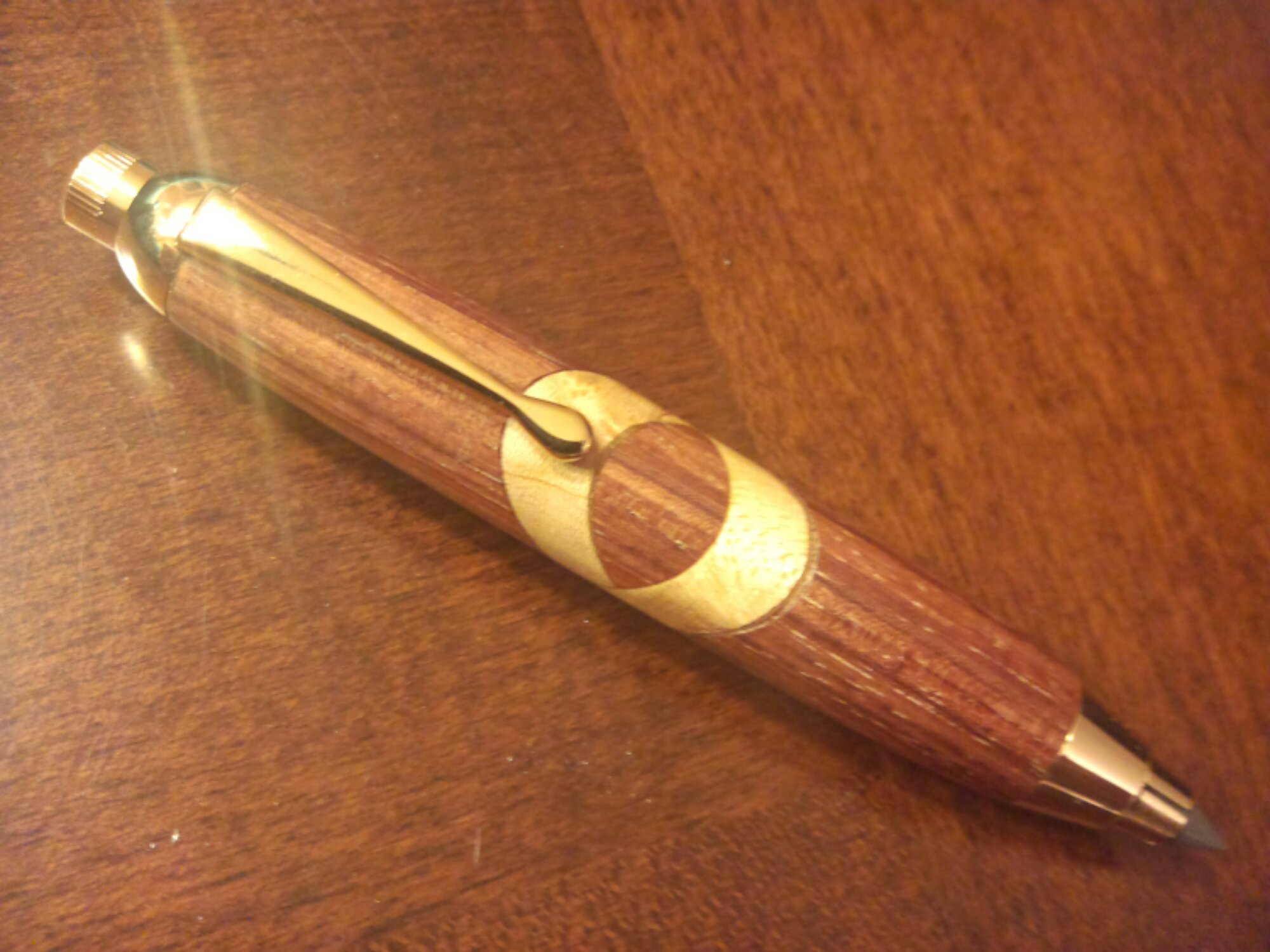
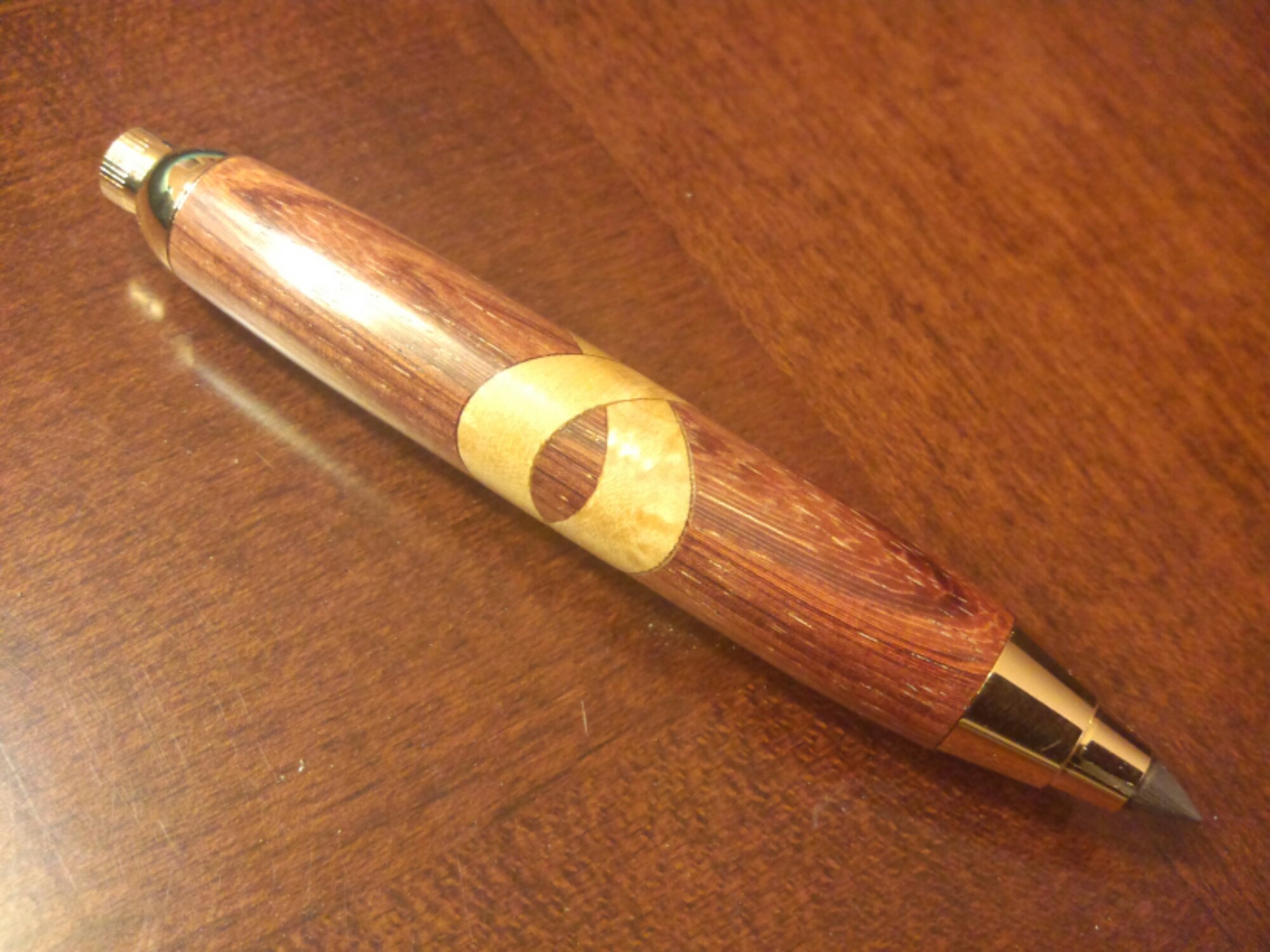
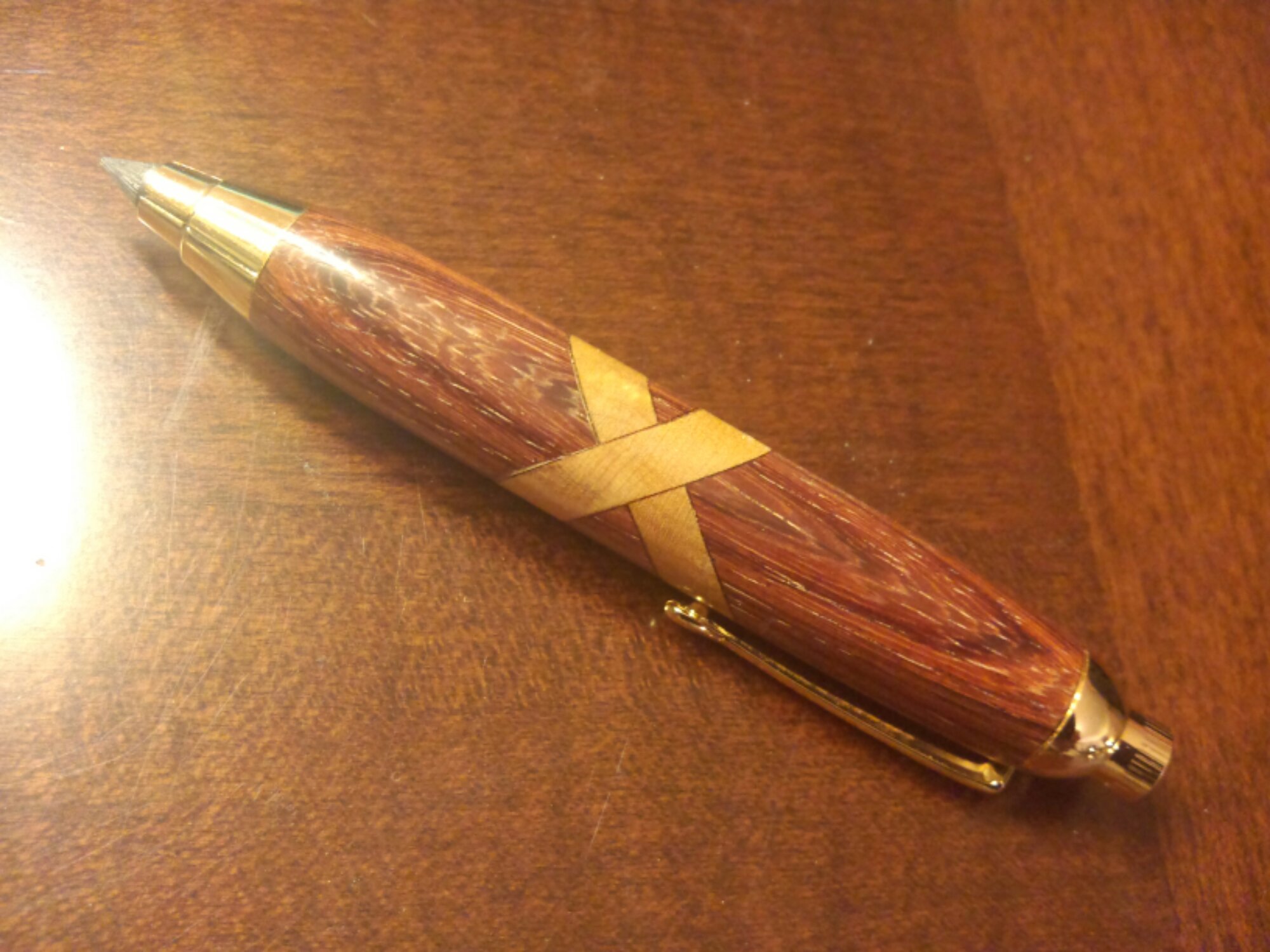
  • A few days ago I glued up a Mun Ebony blank with some slices of 1/4 inch Maple to see if I could actually produce a pen with this type of glue-up.  One of the difficulties I face is that of alignment.  Because I am using only a handsaw, I have tremendous difficulty in cutting the blank squarely.  When I go to glue the angled pieces of the blank together, it doesn’t always go back together squarely with the other half of the blank (if I align the crosses).  The blank a few days ago was so crooked that the drill bit ended up being crooked and too close to the edge of the blank and ended up splitting the wood.  There wouldn’t have been enough on the side to make round on the lathe and so I had to try again. 

    Today I was a bit more careful.  The blank was still wracked a bit when the glueup was finished but I was able to drill the blank, more or less, through the middle.  Turning was difficult because of the difference in densities of the ebony and the maple, but I am pleased with how this turned out.  The cross is still not quite uniform on both sides, but the alignment of the crosses worked well and I am not upset that the loops are inconsistent.

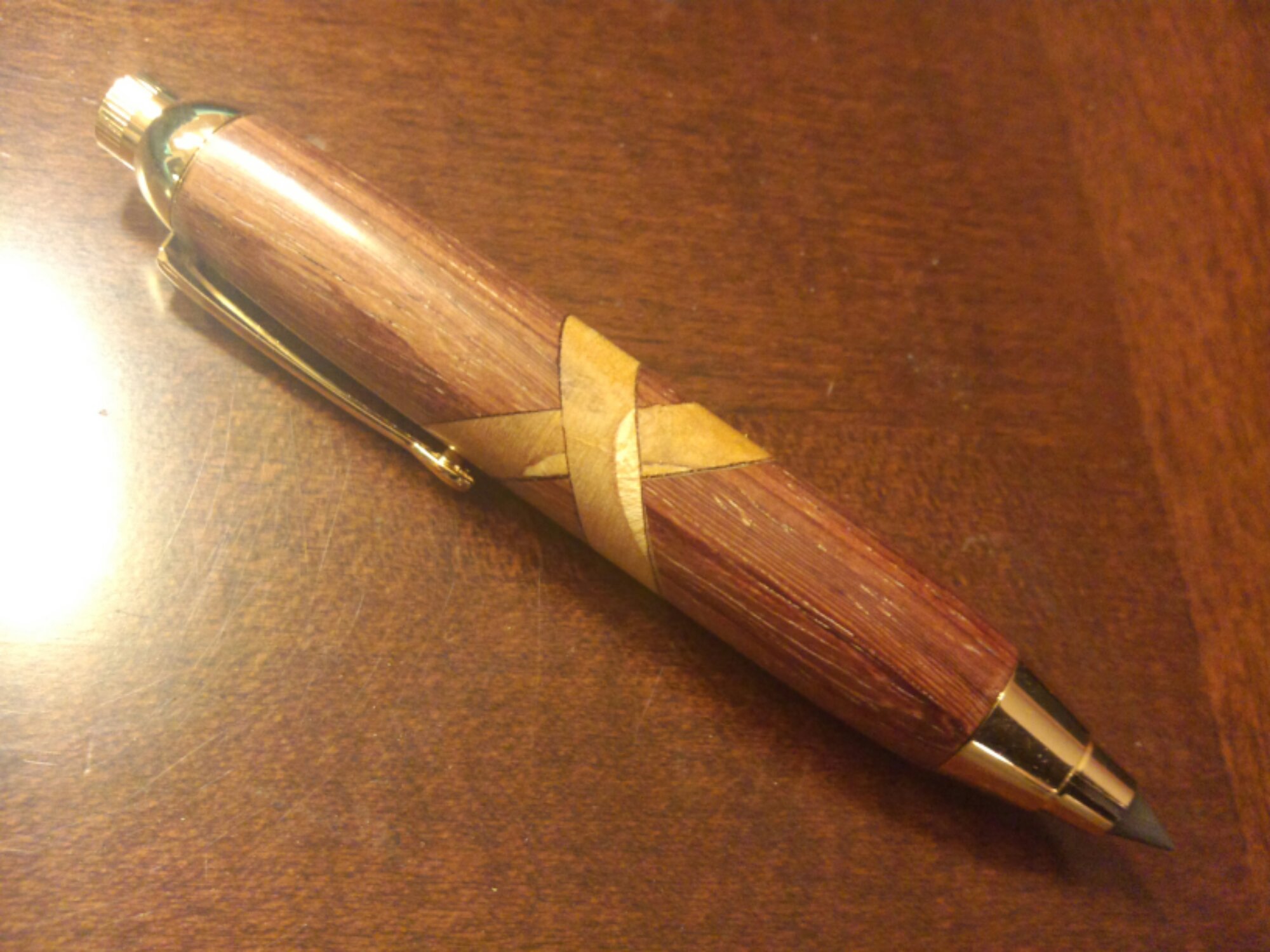
    I finished with micro-mesh, then wiped the blank with rubbing alcohol before I used EEE Cream and then coated the final pencil with Conservator’s Wax.  It is perhaps my favourite product so far with a lovely rich satiny smooth finish.

    image

    image

    image

    image

    Now… I only have three more pens/pencils do do before Christmas.

  • I was asked to make a pen for one of the Veterans who reside at the local Veterans’ residence here in Winnipeg.  The Veterans list always make me sad because they ask for things like deodorant and soap.  Such “routine” necessities in life.  It saddens me that society has all but forgotten these people.  At any rate, there was one veteran on the list who asked for a “fancy pen” and the Trg Clerk who works in my office asked if I would make a pen.  If so, she would adopt this vet.  How can I refuse?  Such a simple request.

    Anyway, bright and early this morning (I probably woke my wife with the machinery) I went down to the shop and made this Purpleheart pen.  Like all the other purpleheart blanks, they start as a very purple blank, but when they are turned, they actually turn out quite brown.  The ones I have made to this point have returned to a deep purple in about 6 months or so.  This is a European Round-top Pen in Chrome.

    image

    One of the amazing things about this blank was how “curly” the pen turned out to be.  It is one of the most pleasing things about turning.  While you can predict to a point what you will see “inside”, there is never any degree of certainty.  With the extent of the curl I decided that a still photograph does not do the pen justice and so I took a little video and posted it to YouTube.  Here it is:

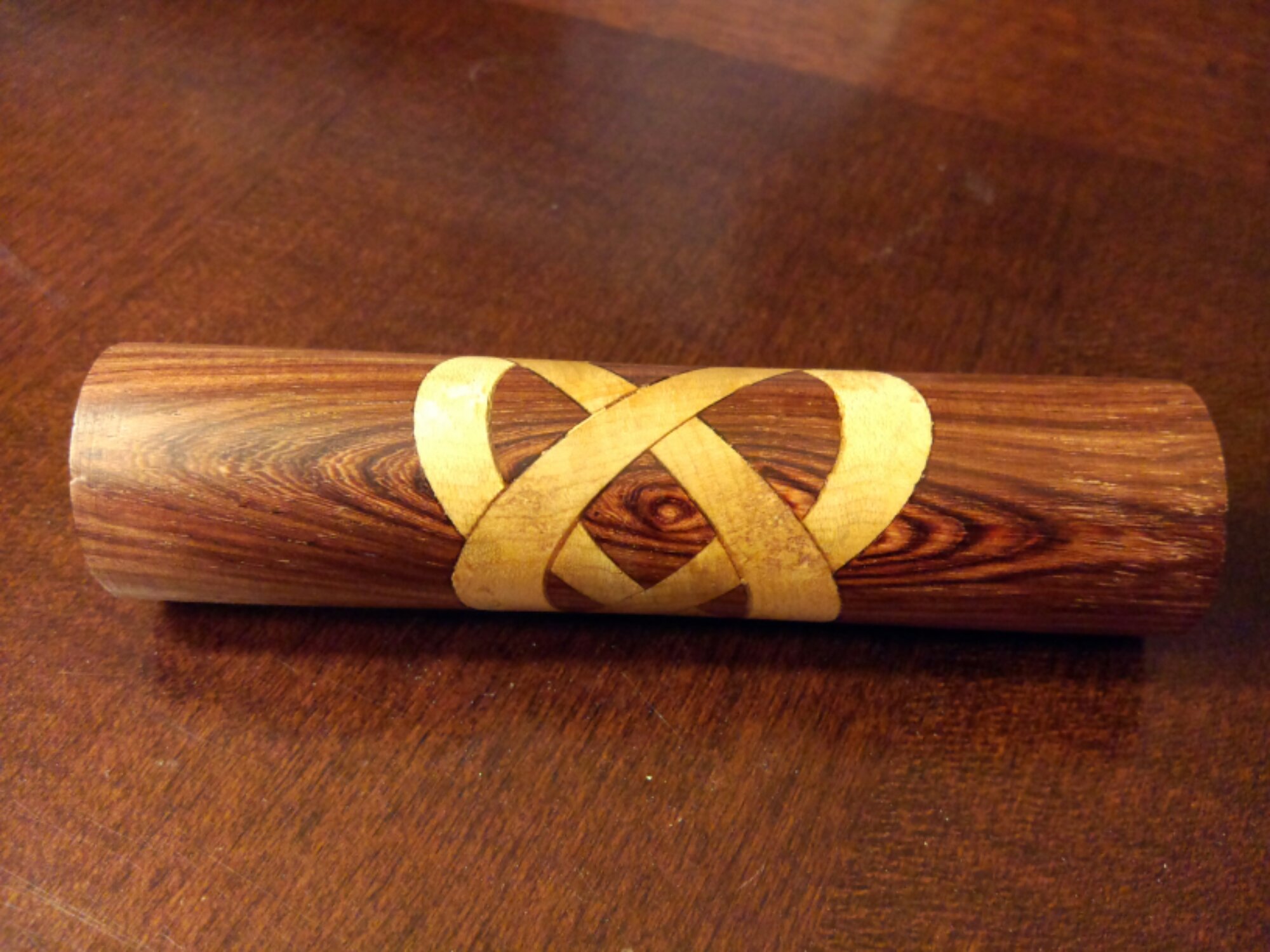
  • I need to make another Artist sketch pencil for the father of one of the staff at work for Christmas.  We had decided on one made of Mun Ebony and yesterday was going to be the day.  I found a blank and when I started looking at it, I realized that it was quite a bit larger than a normal pen blank and so I changed my mind and decided to try my hand at a knot in the blank.  This entails me cutting the blank at a 45 degree angle and glueing a strip of (in this case) bird’s eye maple between the cut.  When dry, you rotate the blank 90 degrees and do the same thing.  In total there are 4 strips of maple glued into the blank.  Next time I do this I will take pictures of the blank as I progress in the glueup.  I used CA glue for the segmenting and so between glue and cutting I only had to wait for about a half hour.  This meant that I could easily get the blank ready in a day.

    This morning I was going to continue with the pencil, but I realized that I had some alignment problems with the blank and, instead of wasting a pen tube on this experiment, I decided to chuck it between spur centres and turn it to see if I figured the geometry correctly.  As you can see, it turned out very well, even though not every “string” of the knot lines up correctly.  I was pretty impressed because I did all the cutting with a handsaw.

    Here is the finished piece.  It is kind of like a Latin Clave although it is smaller than it should be. You can’t really tell the size from the picture. this finished rod is about 4 inches in length and less than 1 inch in diameter.

    image

    image

    image

    The alignment problems are most evident in the second photograph.  Before I do this again, I will have to design a tablesaw sled, so that the cutting can be more uniform.  One of the happy accidents is shown in the third picture.  When turned a branch knot appeared in the ebony, right in the middle of the maple knot.  This is one of the reasons that wood turning is so engaging.  You can’t really plan for things like this and you never know what will happen when you start into a piece of wood.

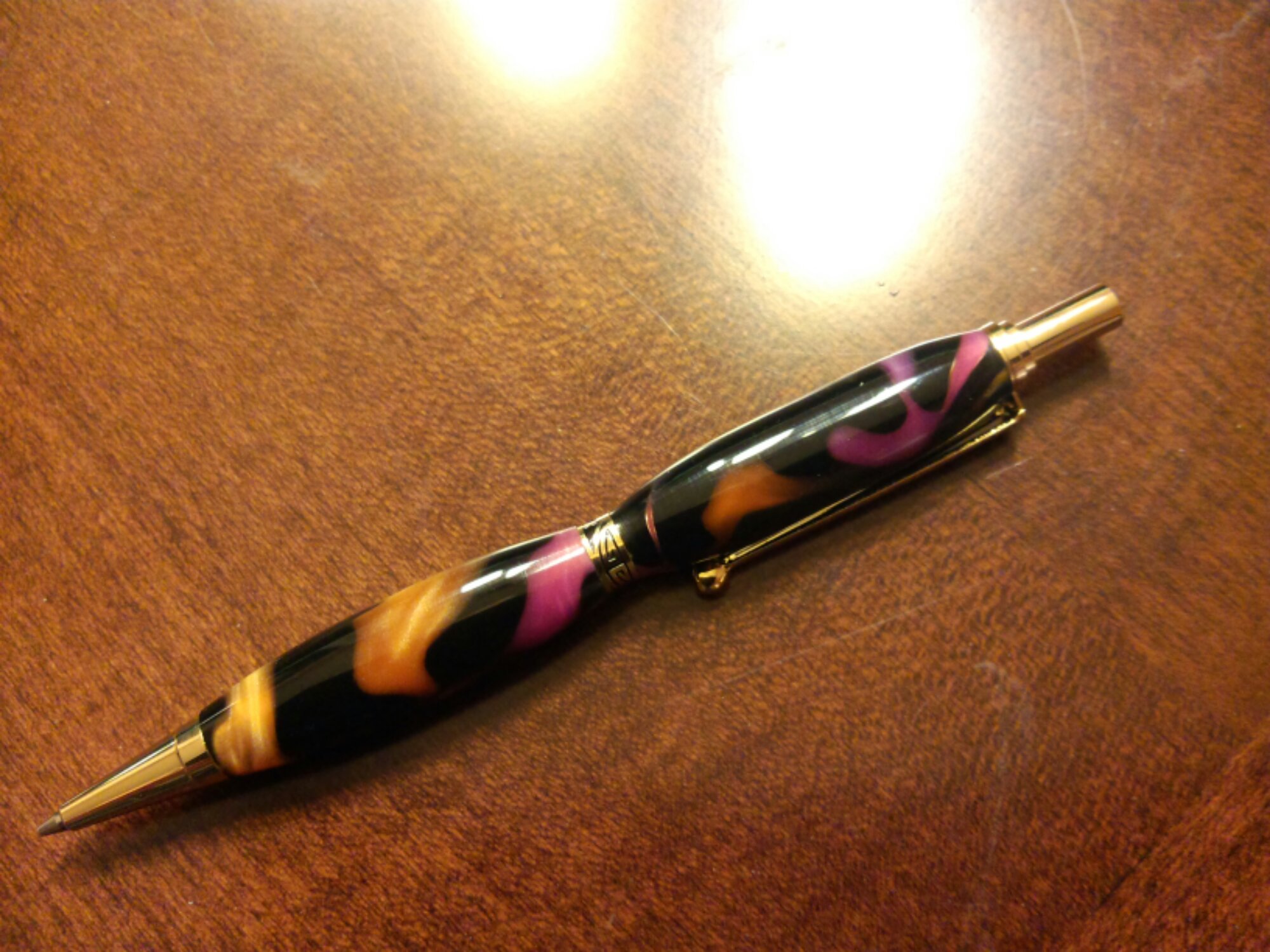
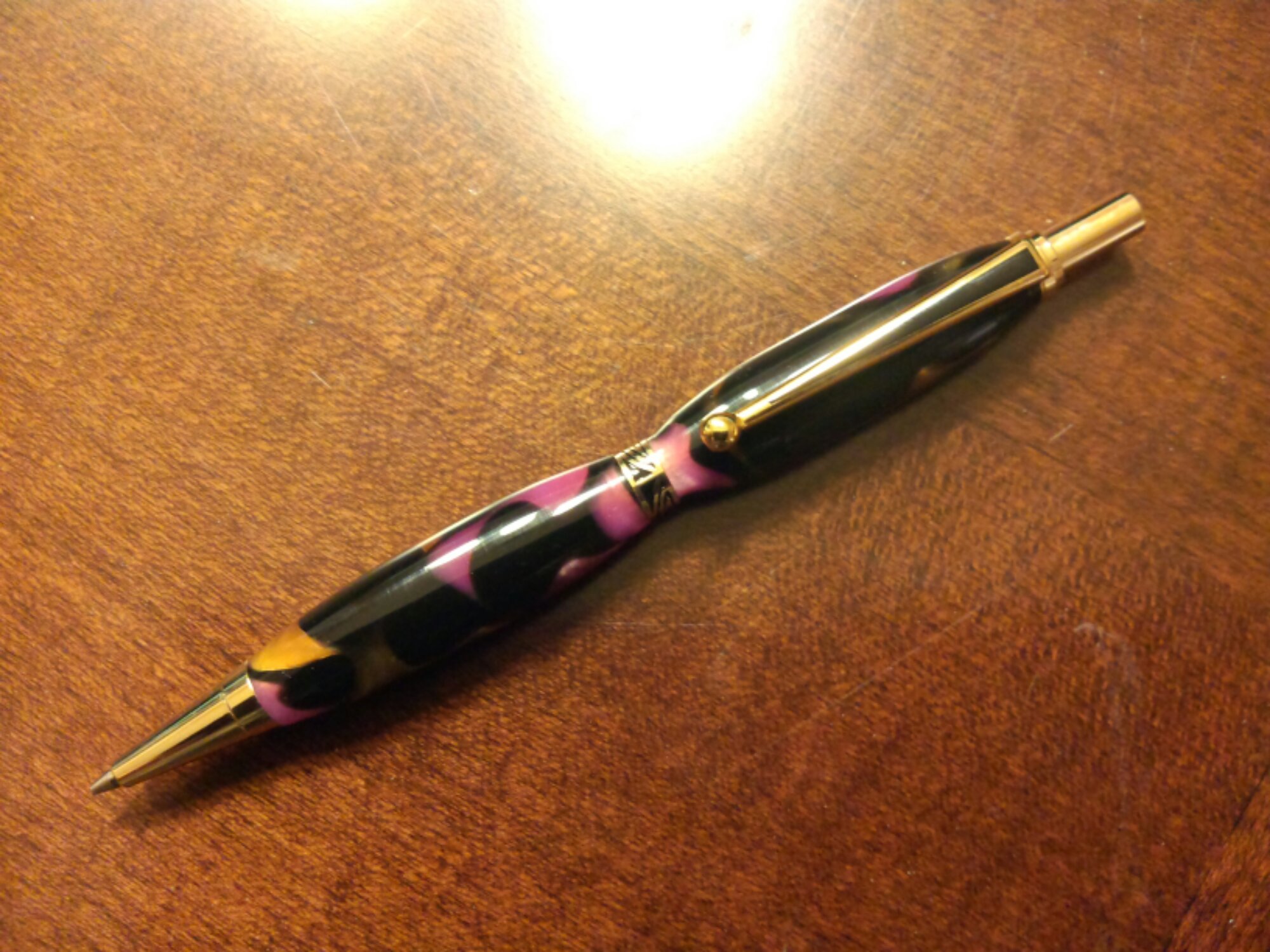
  • I was asked to make a pen for our Training Department’s Christmas gift basket at work and I had a couple of “slimline” kits and thought I would make a pen and pencil set.  I made them out of an acrylic called Licorice Allsorts (for obvious reasons).  When I had them turned, before I started with the micro-mesh finishers, I used my EEE Cream to take out any tools marks that were left in the blank.  The EEE Cream is so named because it has a Tripoli (hence Triple E) grit in it that, through friction, gets finer and finer as you polish with it.  When I was finished with the EEE, the blank had a beautiful lustre with no discernable tool marks.  After the EEE I used my Micromesh finishing pads.  These are a series of 9 pads that start at 1500 grit and step down to 12000 grit.  A great way to polish acrylic, not unlike the way glass is polished.

    image

    This is the pencil from the set.  The fun began after I had the pencil completed.  I turned the pen and it came out very nicely as well.  Unfortunately I made a mistake pressing the transmission in as it went too far to retract the pen tip.  I tried to pull it out with vice grips, but I broke off the transmission at the brass coupler leaving the brass part stuck in the tube.  I decided to try to drill it out, but it was very difficult to hold the piece and I ended up chipping a part of tube away, making it worthless.  At least I got the pencil.

    image